
ESP32-S3-Nano Microcontroller Board
5.0Editor score
ESP32-S3R8 Chip
16MB Flash Memory
Arduino Cloud Compatible
This guide compares the top Arduino Nano ESP32 boards and compatible ESP32 boards to help you choose the right microcontroller for your IoT projects.
Finding the right microcontroller for your next project can be challenging. The Arduino Nano ESP32 offers powerful features in a compact form factor. We explore the best options available today for makers and professionals alike.
We evaluated each board based on performance, connectivity, ease of use, and community support. Our list includes official Arduino boards and high-quality third-party alternatives that meet rigorous standards for reliability and functionality.
Each pick highlights specific strengths and ideal use cases for different types of projects. Prices and availability change frequently, so check the links for the most current information before making your final purchase decision.
5.0Editor score

4.6Editor score

4.7Editor score
This side-by-side comparison highlights the key specifications and unique features of each board to help you quickly identify the best fit for your specific development needs and project requirements.


The Arduino Nano ESP32 stands out as a top choice for modern embedded development. Its powerful ESP32-S3 chip delivers exceptional performance for complex IoT tasks while maintaining the familiar Arduino ecosystem that many developers love.
We may earn a commission when you buy through this link, at no additional cost to you.
This board features comprehensive wireless connectivity with both Wi-Fi and Bluetooth 5.0. The USB-C port ensures reliable power and programming, while HID support opens doors for creating custom input devices without extra hardware.
Although it carries a higher price than generic alternatives, the official support and documentation justify the investment. The MicroPython compatibility also makes it accessible for developers who prefer Python over traditional C++ coding.
If you need a reliable, high-performance board with strong official backing, this is the clear winner. It balances power and ease of use better than any other option on this list for serious projects.
The dual-core Xtensa 32-bit LX7 processor running at 240 MHz handles real-time data processing and machine learning tasks efficiently at the edge.
Built-in Wi-Fi and Bluetooth 5.0 enable direct connection to cloud platforms and mobile apps without needing external modules.
We may earn a commission when you buy through this link, at no additional cost to you.
This ESP32-S3-Nano board offers incredible performance per dollar. It matches the capabilities of more expensive boards while delivering a perfect five-star rating from users who appreciate its reliability and feature set.
We may earn a commission when you buy through this link, at no additional cost to you.
The board includes 16MB of flash memory and 8MB of PSRAM, which is generous for this price range. It supports both Arduino and MicroPython seamlessly, making it versatile for different developer preferences and project types.
While it lacks the official branding of Arduino products, the community feedback confirms it works flawlessly with standard development environments. The integration with Arduino IoT Cloud is a significant bonus for remote monitoring tasks.
For budget-conscious makers or those needing multiple units for prototyping, this board is hard to beat. It provides premium features without the premium price tag, making it ideal for educational or large-scale deployments.
With 8MB PSRAM and 16MB flash, you can store larger programs and datasets without worrying about running out of space during development.
Compatible with Arduino IoT Cloud allowing you to monitor and control projects remotely through a simple mobile app interface.
We may earn a commission when you buy through this link, at no additional cost to you.
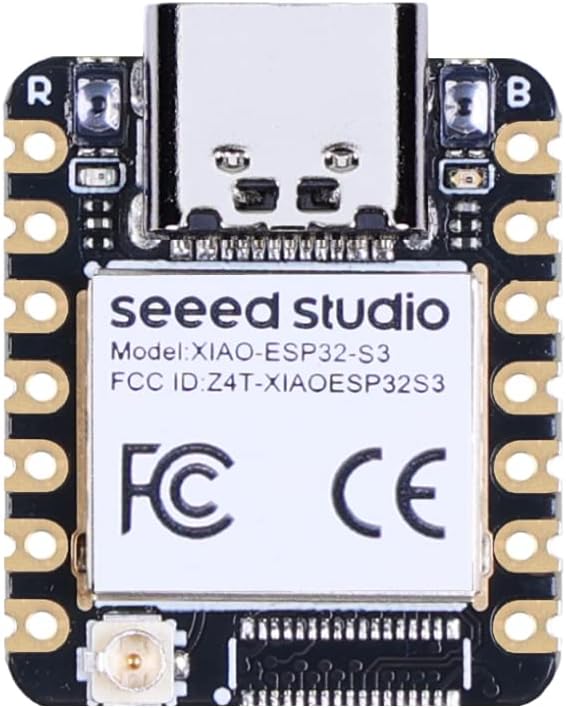
The XIAO ESP32S3 is designed specifically for space-constrained projects. Its thumb-sized footprint makes it perfect for wearable devices or embedded systems where physical dimensions are critical constraints.
We may earn a commission when you buy through this link, at no additional cost to you.
It features an elaborate power design that supports lithium battery charging. With four power consumption models, it can enter deep sleep mode using as little as 14 microamps, extending battery life significantly.
Despite its small size, it maintains powerful dual-core processing and excellent wireless range. The U.FL antenna support allows for better range when needed, while the SMD design ensures durability in production environments.
If you are building wearables or portable IoT sensors, this board is arguably the best choice. Its balance of power, efficiency, and size is unmatched, making it a favorite among hardware engineers and makers alike.
The advanced power management allows for ultra-low power modes essential for battery-operated devices that need to run for months on a single charge.
The SMD design with no components on the back makes it easier to integrate into custom PCBs for professional manufacturing runs.
We may earn a commission when you buy through this link, at no additional cost to you.
This board takes a different approach by using the RISC-V architecture alongside the ESP32-P4 chip. It is tailored for projects that require heavy image or voice processing capabilities right at the edge device level.
We may earn a commission when you buy through this link, at no additional cost to you.
It includes specialized hardware for JPEG decoding and H264 encoding, which offloads tasks from the main CPU. This makes it exceptionally suitable for camera modules or voice recognition projects that need real-time performance.
The inclusion of security features like Secure Boot and Flash Encryption adds peace of mind for commercial applications. The variety of interfaces including MIPI-DSI allows direct connection to displays without extra controllers.
While it has a steeper learning curve due to its advanced feature set, it is unmatched for multimedia applications. If your project involves video or advanced image analysis, this is the board to consider.
Onboard Image Signal Processor and Pixel Processing Accelerator handle complex visual tasks without slowing down the main application logic.
Hardware access protection and cryptographic accelerators ensure your device meets enterprise-level security standards out of the box.
We may earn a commission when you buy through this link, at no additional cost to you.
Waveshare offers this board in a three-pack, which is excellent for teams or projects requiring multiple nodes. The ESP32-S3FH4R2 chip provides reliable performance consistent with the standard ESP32-S3 series.
We may earn a commission when you buy through this link, at no additional cost to you.
The castellated module design allows you to solder the board directly onto a custom carrier board. This is particularly useful if you are designing a custom PCB where you need to integrate the microcontroller permanently.
While it lacks a built-in USB-C connector, it compensates with flexible power settings that allow you to optimize energy consumption for specific use cases. The ceramic antenna provides solid wireless performance for indoor use.
For projects needing multiple units like sensor arrays, buying a 3-pack is more economical than individual boards. It is a practical choice for industrial prototyping where modular assembly is key.
Castellated module pads enable direct soldering onto PCBs, making it ideal for permanent installations or custom carrier boards.
The three-pack format reduces unit cost significantly, making it perfect for scalable IoT deployments requiring multiple identical nodes.
We may earn a commission when you buy through this link, at no additional cost to you.
This kit is perfect for those just starting their journey into ESP32 development. It includes over 35 different modules and components, ensuring you have everything needed to build diverse projects from scratch.
We may earn a commission when you buy through this link, at no additional cost to you.
The online tutorial offers 30+ projects with complete code and clear diagrams. This step-by-step approach helps beginners understand how to wire circuits and write code without getting overwhelmed by technical details.
While the core board is standard, the value comes from the comprehensive component selection. It allows you to experiment with sensors, motors, and displays immediately after unboxing, accelerating your learning curve.
If you want a guided learning experience, this kit is highly recommended. It saves time searching for individual parts and provides a structured path from basic circuits to advanced IoT applications.
Includes sensors, displays, and input devices all selected for compatibility, so you can start building immediately without extra purchases.
Detailed tutorials guide you through fundamental concepts, ensuring you build a solid foundation before tackling more complex projects.
We may earn a commission when you buy through this link, at no additional cost to you.
The Nano 33 IoT is built specifically for secure cloud connections. Its u-blox NINA-W102 module provides reliable Wi-Fi and Bluetooth connectivity, while the secure element ensures your data remains protected from unauthorized access.
We may earn a commission when you buy through this link, at no additional cost to you.
With a powerful ARM Cortex-M0+ processor, it handles standard IoT tasks efficiently. The pre-soldered headers make it easy to connect to breadboards, and the secure element adds hardware-level encryption for cloud communication.
While it lacks the raw power of the ESP32-S3, its focus on security makes it ideal for commercial or enterprise IoT deployments. It is trusted by many professionals who prioritize data integrity over maximum processing speed.
If your project involves sensitive data or connects to a cloud service, this board is the safe bet. It balances official support and security features better than most other small boards on the market.
The u-blox ATECC608A Secure Element ensures that communications with cloud platforms are encrypted at the hardware level for enhanced security.
Despite its small size, the board supports both Wi-Fi and BLE, enabling versatile wireless interactions without external modules.
We may earn a commission when you buy through this link, at no additional cost to you.
This board uses the original ESP32 architecture that made the brand famous. It offers stable Wi-Fi and Bluetooth 4.2 connectivity with a proven track record in thousands of hobbyist and industrial projects.
We may earn a commission when you buy through this link, at no additional cost to you.
The integrated antenna saves space and simplifies board layout. It supports Freertos out of the box, allowing for efficient multi-threaded application development that takes advantage of the dual-core architecture.
While newer chips like ESP32-S3 offer more features, this classic version remains popular due to its simplicity and reliability. It is particularly well-suited for projects where proven stability matters more than cutting-edge specs.
For general IoT development where you don't need the latest AI features, this is a solid choice. It works seamlessly with the Arduino IDE and has a massive community base for troubleshooting and support.
The ESP32 chip has been battle-tested in millions of projects, making it a reliable choice for critical applications where stability is key.
Supports AP, STA, and AP+STA modes, giving you full control over how your device connects to networks or acts as a hotspot.
We may earn a commission when you buy through this link, at no additional cost to you.
ELEGOO offers a modern twist on the classic ESP32 by including a USB-C port. This 3-pack provides excellent value while allowing you to use up-to-date connectors for power and programming.
We may earn a commission when you buy through this link, at no additional cost to you.
The CP2102 USB-to-serial chip ensures stable connections, and OTA support means you can update firmware over Wi-Fi once deployed. This convenience is a massive plus for maintenance in remote installations.
With a 4.7-star rating, these boards are highly trusted by users who appreciate the balance of price and functionality. They are perfect for projects needing multiple nodes without breaking the budget.
If you need USB-C and the convenience of OTA updates at a low cost, these boards are ideal. They combine the reliability of the ESP32 core with the modern convenience of newer interfaces.
The USB-C port offers reversible plug support and faster power delivery compared to older micro-USB connections.
OTA support allows you to update firmware wirelessly, reducing the need to physically reconnect devices after deployment.
We may earn a commission when you buy through this link, at no additional cost to you.
The UNO R4 WiFi combines two powerful processors: a Renesas RA4M1 for logic and an ESP32-S3 for wireless connectivity. This dual-core approach provides flexibility and performance unmatched by single-chip solutions.
We may earn a commission when you buy through this link, at no additional cost to you.
It features a built-in 12×8 LED matrix for instant visual feedback without external displays. Additional features like CAN support and a Qwiic connector make it a powerhouse for industrial or robotic applications.
While it is larger and more expensive than the Nano, the built-in peripherals save space and wiring complexity. It is designed for users who need a comprehensive solution right out of the box.
If you are looking for a premium board with advanced analog capabilities and industrial-grade connections, this is the top choice. It brings professional features to the Arduino ecosystem for serious projects.
The Renesas RA4M1 handles real-time control tasks while the ESP32-S3 manages wireless communication efficiently.
The 12×8 LED matrix allows you to display status and messages without needing additional display hardware.
We may earn a commission when you buy through this link, at no additional cost to you.
Selecting the right microcontroller requires understanding your project's specific needs. Here are the key factors to consider before making your decision.
The processor determines how quickly your board can handle complex calculations. For general IoT tasks, the ESP32-S3 dual-core processor is more than sufficient. However, if you are doing image processing or advanced machine learning, consider boards with dedicated accelerators.
Look for boards with higher clock speeds if your application involves real-time data processing or multiple concurrent tasks.
Memory includes Flash and SRAM. Flash stores your code while SRAM handles active data. If you plan to store large datasets or use machine learning models on the device, prioritize boards with higher PSRAM and Flash specifications.
Ensure the board has at least 4MB of Flash and sufficient SRAM to run your application smoothly without crashes or memory errors.
Most boards offer Wi-Fi and Bluetooth, but versions vary. Bluetooth 5.0 provides better range and battery efficiency than older versions. Additionally, consider if you need Ethernet or CAN bus support for industrial environments.
Choose a board with the wireless protocols your project requires. Bluetooth 5.0 is now standard for better performance in crowded environments.
For battery-powered projects, low power consumption is vital. Look for deep sleep modes and low quiescent current. Some boards like the XIAO ESP32S3 are specifically designed for energy efficiency.
Select a board with optimized power modes if your device needs to run for months without recharging or frequent battery changes.
USB-C is becoming the standard for modern development boards. It offers reversible connectivity and faster data transfer. Avoid older Micro-USB boards unless you are upgrading from legacy equipment.
Ensure the board uses USB-C for modern convenience and better power delivery capabilities during development and prototyping.
While C++ is standard for Arduino, MicroPython support simplifies development for many users. Check if the board supports the language you are comfortable with to speed up your development cycle.
If you prefer scripting over compiled code, verify that the board has active MicroPython support to reduce setup time and complexity.
Official Arduino boards usually have better documentation and community support. Third-party boards may be cheaper but can lack tutorials. Ensure the ecosystem around the board is active for help.
Stick to well-supported boards if you are new to embedded development to avoid getting stuck with technical issues.
Size matters for portable or wearable projects. Boards like the XIAO ESP32S3 are thumb-sized and ideal for wearables. Larger boards like the UNO R4 provide more headers but take up more space.
Consider the space constraints of your project when selecting a board size to ensure it fits comfortably inside your enclosure.
To get started, install the Arduino IDE on your computer and add the necessary board manager URLs. Connect the board via USB-C and select the correct COM port in the IDE settings.
Always handle the board carefully to avoid static discharge. Store it in a dry place away from direct sunlight and extreme temperatures to maintain longevity.
Regularly update your software libraries and firmware to benefit from security patches and performance improvements. Keep your project code backed up to avoid losing progress.
The Arduino Nano ESP32 is generally better due to its stronger ESP32-S3 chip and USB-C connectivity. It offers more processing power and modern features compared to the older Nano 33 IoT architecture.
Many of the boards like the Arduino Nano ESP32 support MicroPython natively. This allows for easier scripting and faster development compared to using C++ in the Arduino IDE.
The ELEGOO ESP-32 Super Starter Kit is ideal for beginners because it includes components and tutorials. It provides a guided path to learning without needing to source parts separately.
Most standard boards support 2.4GHz Wi-Fi. While some newer chips like the ESP32-P4 have advanced wireless modules, most consumer boards are limited to standard 802.11 b/g/n protocols.
The Seeed Studio XIAO ESP32S3 is excellent for battery projects due to its deep sleep modes and built-in battery charging. It consumes as little as 14 microamps in low power states.
Yes, if you need advanced features like the built-in LED matrix, CAN bus, and dual-core processing. It offers more functionality out of the box compared to standard ESP32 boards.
The Arduino Nano ESP32 stands out as the overall best choice for its balance of performance and official support. For budget needs, the ESP32-S3-Nano offers incredible value without sacrificing key features.
Prioritize memory and connectivity options based on your project requirements. If you need advanced features like image processing or industrial connectivity, consider the ESP32-P4-NANO or UNO R4 WiFi.
Remember that prices fluctuate, so verify current deals before purchasing. We hope this guide helps you find the perfect board for your next IoT or embedded project.