
TRENDnet TEG-S50284
4.8Editor score
24 ports 2.5G RJ45
4 ports 10G SFP+
Lifetime manufacturer protection
This guide compares the top 25GbE switches with SFP28 ports for high performance networks ensuring you choose the right hardware for your specific infrastructur
Modern data centers require high bandwidth connectivity to support demanding applications like artificial intelligence and large scale storage. Choosing the right switch is critical for maintaining speed and reliability across your network infrastructure effectively.
We evaluated ten leading models based on port configurations performance features and overall value. Each option offers unique strengths for different environments ranging from small businesses to enterprise grade facilities.
Each pick highlights key capabilities and ideal use cases to help you decide. Prices and availability change frequently so check current listings before purchasing to ensure you get the best deal available today.
4.8Editor score

5.0Editor score

4.6Editor score
The following table provides a side by side comparison of all ten switches listed in this guide. We highlight core specifications to help you quickly identify the model that fits your port speed and feature requirements.





The Cisco N9K-C93180YC-EX stands out as the top choice for high performance data center environments. With a perfect rating and unmatched connectivity options it delivers consistent speeds for demanding workloads.
We may earn a commission when you buy through this link, at no additional cost to you.
Its cut-through switching architecture minimizes latency ensuring smooth big data processing. Support for VXLAN enables scalable network virtualization while hot-swappable power supplies keep operations running uninterrupted around the clock.
While this model offers enterprise grade features the complexity of NX-OS might challenge smaller teams. Additionally renewed units may show cosmetic wear though functionality remains professionally tested and verified by vendors.
Ideal for large scale data centers this switch maximizes availability and future-proofs your investment. It is the ultimate choice for organizations needing high performance computing and robust network automation.
The cut-through switching architecture ensures latency stays under one microsecond. This is vital for high performance computing where every millisecond counts during data processing tasks.
VXLAN support allows you to create scalable and highly available networks easily. This simplifies the management of virtual and physical networks for complex enterprise setups.
We may earn a commission when you buy through this link, at no additional cost to you.
The TRENDnet TEG-S50284 offers exceptional value for small to medium businesses needing fast connectivity. Its 2.5G ports deliver multi-gigabit speeds over existing cabling while the 10G uplinks provide sufficient bandwidth.
We may earn a commission when you buy through this link, at no additional cost to you.
TRENDnet backs this switch with lifetime protection and reliable English-speaking tech support. It is also NDAA compliant for government installations. Smart fans adjust speed to save energy and reduce noise effectively.
The main limitation is that SFP ports only support 10G limiting future 25G uplinks. However for budget conscious users prioritizing current needs this remains a solid cost-effective solution.
Choose this if you need reliable performance without breaking the bank. It is perfect for offices upgrading from 1G networks where 10G backhaul is sufficient for now.
This switch allows you to utilize existing Cat5e cabling for speeds up to 2.5Gbps. This significantly reduces the cost of upgrading your network infrastructure compared to new cabling.
TRENDnet provides lifetime manufacturer protection giving you long-term confidence. This warranty ensures your investment is secure against defects or performance issues over time.
We may earn a commission when you buy through this link, at no additional cost to you.
The Mikrotik CRS520-4XS-16XQ-RM is a powerhouse for advanced network engineers requiring maximum flexibility. It boasts a powerful CPU and ample RAM to handle complex routing and switching tasks simultaneously.
We may earn a commission when you buy through this link, at no additional cost to you.
Its 28 SFP28 ports provide high density 25GbE connectivity essential for clustering. The 100G QSFP28 ports enable high bandwidth uplinks making it ideal for spine leaf topologies in modern data centers.
MikroTik RouterOS offers deep control but demands technical expertise to configure properly. The cost is high compared to simpler managed switches so it suits specialized environments needing advanced customization.
Select this for high performance computing or research clusters where control matters most. It delivers unmatched processing power for users willing to invest time in configuration and maintenance.
With twenty-eight SFP28 ports this switch supports dense server connectivity. This is crucial for AI clustering or virtualization environments needing high parallel bandwidth.
The quad-core CPU running at 2GHz ensures fast packet processing. Combined with 4GB of DDR4 RAM it handles complex routing protocols without slowing down traffic.
We may earn a commission when you buy through this link, at no additional cost to you.
The UniFi Aggregation Switch Pro bridges the gap between access and core layers. It supports 25G ports for high-speed uplinks while integrating seamlessly with existing UniFi network ecosystems.
We may earn a commission when you buy through this link, at no additional cost to you.
Its touchscreen displays system insights quickly. Layer 3 switching features enable smart routing. You can manage it via the UniFi app making it easy for remote monitoring and configuration.
The 25G ports do not support mixed speeds when configured at 25Gbps. This is a trade-off for performance. It is best for those already invested in the UniFi brand.
This switch is perfect for businesses using UniFi devices needing more power. It simplifies network aggregation without complicating management. A solid choice for unified infrastructures.
The UniFi Network application allows centralized monitoring. You can manage settings and view stats from anywhere easily. This reduces the need for multiple management tools.
Four 25G ports create fast links to your core. The 760Gbps switching capacity handles heavy traffic loads. This ensures smooth performance for growing bandwidth demands.
We may earn a commission when you buy through this link, at no additional cost to you.
The Dell EMC PowerSwitch N3224P-ON is designed for environments needing both high-speed data and PoE power. It offers significant flexibility with mixed speeds and robust uplink capabilities for scalability.
We may earn a commission when you buy through this link, at no additional cost to you.
Its 25G SFP28 ports and 100G QSFP28 uplinks support future growth. PoE++ allows you to power devices like cameras or APs directly. This simplifies cabling and reduces costs for access layers.
Power consumption is high at nearly 1kW. This requires adequate cooling and power planning. It is built for enterprise racks where performance and reliability outweigh energy concerns.
Choose this if you need to power devices and move data simultaneously. It is excellent for smart buildings or campuses. A versatile choice for modern infrastructure.
Ports support speeds from 1G up to 25G. This flexibility lets you connect diverse devices. You can upgrade selectively without replacing the whole switch.
PoE++ provides high power to connected devices. This supports high-demand equipment without extra cabling. It streamlines the installation of wireless access points.
We may earn a commission when you buy through this link, at no additional cost to you.
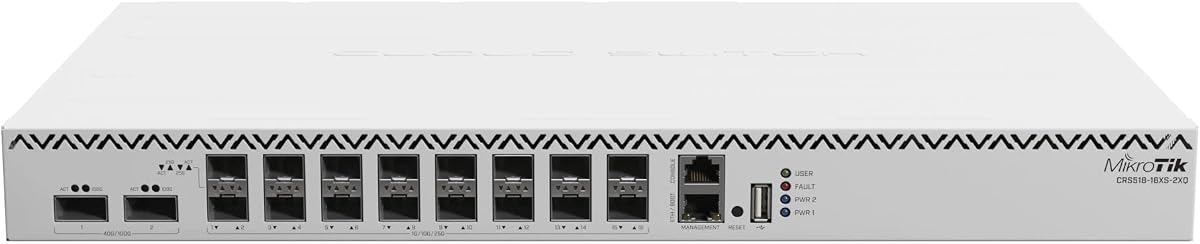
The MikroTik CRS518-16XS-2XQ-RM is a compact solution for high-speed access layers. It packs sixteen 25G ports into a small chassis. This fits well in edge racks needing fiber connectivity.
We may earn a commission when you buy through this link, at no additional cost to you.
RouterOS offers extensive configuration options for network professionals. The QSFP28 ports provide fast uplinks. Despite lower CPU speed it handles switching tasks efficiently. It is cost effective for specific needs.
Configuration can be difficult for beginners. The interface is powerful but not as intuitive as consumer gear. You need networking knowledge to unlock its full potential effectively.
This is a great pick for ISPs or labs. It provides density and speed in a small footprint. A solid option for advanced users on a budget.
This switch fits into tight spaces while delivering speed. The 1U form factor saves rack space. You get many ports without needing a large unit.
RouterOS provides granular control over traffic. You can set up complex routes easily. This flexibility is perfect for custom network architectures.
We may earn a commission when you buy through this link, at no additional cost to you.
The TRENDnet TEG-3284WS is designed for easy management. It offers a web interface that simplifies setup. This makes it accessible for teams without dedicated IT staff.
We may earn a commission when you buy through this link, at no additional cost to you.
VLAN support allows traffic segmentation. Smart fans help with cooling. Lifetime warranty provides peace of mind. Cloud service enables remote monitoring if needed.
Reviews suggest some reliability issues. The feature set is basic compared to enterprise gear. It is best for small offices needing simple segmentation and speed.
Pick this for cost-effective management. It balances ease of use with decent performance. Ideal for SMBs prioritizing simplicity over advanced features.
The GUI is easy to use. You can configure settings via a browser. This reduces the need for command-line expertise.
A lifetime warranty covers defects. This ensures long-term support. You can rely on the product for years without worry.
We may earn a commission when you buy through this link, at no additional cost to you.
The D-Link DGS-1210-28 is a quiet choice for offices. Its fanless design ensures silent operation. This is vital for workspaces needing minimal noise.
We may earn a commission when you buy through this link, at no additional cost to you.
It offers L2+ features like VLANs and QoS. Energy efficiency helps reduce costs. NDAA compliance suits government projects. Lifetime warranty adds value to the purchase.
It only supports Gigabit speeds not 25G. This limits use for high bandwidth tasks. It is best for standard office LANs rather than data centers.
Choose this for silent reliable performance. It is perfect for libraries or studios. A great option for environments where noise matters.
No moving parts mean zero noise. This protects the environment from heat. It is perfect for quiet office spaces.
IEEE 802.3az compliance saves power. This reduces operational costs. The switch consumes less energy while running.
We may earn a commission when you buy through this link, at no additional cost to you.
This renewed Cisco Nexus switch offers forty-eight 25G ports. It is a cost-effective way to get enterprise power. Dual AC power ensures availability during power issues.
We may earn a commission when you buy through this link, at no additional cost to you.
Inspected and tested by vendors it works reliably. It supports high-density clustering. The price is attractive for labs or non-critical environments. You get top-tier specs at a fraction of the cost.
Accessories may not be original. There might be cosmetic signs of use. These are minor issues compared to the performance value. It fits budget-conscious buyers well.
Select this for affordable high density. It is great for testing or temporary setups. A smart pick for those needing many ports now.
Forty-eight ports allow massive connectivity. This suits server farms or labs. You can connect many devices without buying two switches.
Dual power supplies offer redundancy. This prevents outages if one fails. It is essential for maintaining uptime in your network.
We may earn a commission when you buy through this link, at no additional cost to you.
The QNAP QSW-M7230 is purpose-built for AI and NAS workloads. It offers high bandwidth with non-blocking throughput. Lossless features like PFC make it ideal for storage.
We may earn a commission when you buy through this link, at no additional cost to you.
It supports static routing and VLANs via web GUI. Top-of-rack design fits server rooms perfectly. You can scale to 100G easily. It bridges old 10G to new fiber backbones.
It is specialized for storage needs. Advanced features might be overkill for general office use. However for media production it excels. It reduces bottlenecks effectively.
Ideal for high-res media production workflows. Choose this if you rely heavily on NAS. It ensures smooth data transfer for teams.
This switch is tuned for storage traffic. Lossless performance minimizes packet loss. It ensures your large files move without interruption.
With 100G uplinks you can grow without replacing. It supports seamless migration. Your network stays relevant as speeds increase over time.
We may earn a commission when you buy through this link, at no additional cost to you.
Selecting the right switch requires understanding your specific port speed needs and budget constraints.
Determine how many 25G ports you need versus 10G or 100G uplinks. High density options allow you to connect many servers without adding more racks.
Aim for enough ports to handle current needs plus some spare capacity for expansion.
Managed switches let you configure VLANs QoS and static routing. This provides security and control. Unmanaged units are simple plug-and-play devices.
Choose managed if you need traffic segmentation or specific network policies.
High performance switches generate heat and consume energy. Check power ratings to ensure your rack power supply is adequate. Fanless units are quieter but may throttle under load.
Ensure your environment has proper airflow to prevent overheating.
Layer 2 handles local traffic. Layer 3 adds routing capabilities. This allows subnets and better traffic management. L3 Lite offers basic routing for simple setups.
Go with Layer 3 if you need inter-subnet communication.
Most enterprise switches are 1U rack mountable. Ensure you have the rack rails. Airflow direction (front-to-back or back-to-front) must match your cooling system.
Verify dimensions and mounting kit availability before purchasing.
Look for switches with higher speed uplinks like 100G. This allows you to scale bandwidth later without replacing the whole unit. Ensure SFP28 ports are flexible enough.
Invest in hardware that supports future speeds to extend its lifespan.
Enterprise switches often come with support contracts or lifetime warranties. Check what is included. Reliable tech support helps during failures.
Prioritize brands known for responsive assistance.
Prices vary widely. Renewed units offer savings but require careful checks. New premium units cost more but guarantee freshness.
Balance upfront cost with long-term operational savings and reliability.
Always use compatible SFP28 modules or cables. Mismatched optics can cause errors or link failures. Verify that your fiber transceivers match the switch vendor or are compatible.
Place the switch in a well-ventilated rack. Keep it away from direct sunlight or other heat sources. Ensure fans can draw in cool air and expel hot air efficiently.
Regularly check logs for port errors. Use SNMP or web interfaces to monitor uptime. Update firmware periodically to patch security vulnerabilities and improve performance.
SFP+ supports up to 10Gbps. SFP28 supports up to 25Gbps. SFP28 modules are physically similar but have higher speed capabilities. You can use SFP+ in SFP28 ports for 10G but not vice versa.
Yes you typically need high-quality fiber or DAC cables. Copper Cat6a might support short runs. Ensure cables are rated for 25G speeds to avoid bottlenecks.
Most modern switches support mixed speeds. Some have limitations on specific ports. Check the manual to ensure your configuration allows mixed speeds per the port group.
Priority Flow Control prevents packet loss during congestion. It is vital for storage traffic like RoCE. Lossless performance ensures your data transfer is reliable.
Not always. For simple networks a basic switch works. Managed switches offer VLANs and security. Use them if you need segmentation.
Start by adding 25G ports to your core or access layer. Connect servers with SFP28 links. Ensure your uplinks handle the increased traffic load.
100G uplinks provide massive backhaul bandwidth. They prevent bottlenecks at the core. This is essential for scaling clusters or large data centers.
We reviewed ten top switches ranging from budget-friendly models to enterprise solutions. The Cisco N9K-C93180YC-EX stands out for pure performance while TRENDnet offers value for smaller offices.
Prioritize port density and speed based on your current needs. If you are investing in AI or storage ensure you look for lossless features like PFC and strong support.
Prices and availability shift frequently so check current listings on the retailer sites. Your best option depends on your budget and specific workload requirements.