
Entina Tina2C
4.4Editor score
WiFi control
STEM modules
Auto leveling
This guide compares the top 3D printer for educational use models based on safety, ease of use, features, and learning tools for students.
Choosing the right 3D printer for educational use requires balancing safety, ease of use, and robust features that support STEM learning goals effectively.
We evaluated ten leading models based on calibration speed, safety certifications, software integration, and real-world performance in classroom and home learning environments.
Each pick highlights key strengths and trade-offs to help you decide which machine fits your budget and teaching needs without risking failed projects or downtime.
4.4Editor score

4.7Editor score

4.7Editor score
The following table provides a quick side-by-side overview of the most relevant specifications and standout features for each model considered in this guide.



The Bambu Lab A1 earns our top pick for educational use due to its effortless setup and highly reliable automated calibration process.
We may earn a commission when you buy through this link, at no additional cost to you.
Its full auto calibration handles Z offset and leveling so students can focus on design rather than manual adjustments or failed beds.
The active flow compensation ensures smooth extrusion even at high speeds, while the quiet motor noise canceling keeps the classroom environment calm.
We recommend this model for educators who want a dependable tool that reduces maintenance time and maximizes productive learning sessions.
Automatic calibration removes the guesswork from bed leveling, allowing students to start printing almost immediately after powering on.
Despite its ease of use, the A1 delivers professional-grade accuracy, making it suitable for both beginner and intermediate design projects.
We may earn a commission when you buy through this link, at no additional cost to you.
The Entina Tina2C is designed specifically for young learners, offering a guided setup that allows a first print in as little as eight minutes.
We may earn a commission when you buy through this link, at no additional cost to you.
Its integrated STEM learning courses and AI search features turn printing into an interactive lesson, bridging the gap between creative play and technical skill.
While the build volume is small, it is perfect for classroom demonstrations or individual student projects where quick iteration matters more than large parts.
Educators looking for an affordable, safe, and curriculum-aligned tool will find this printer delivers high value with minimal technical barriers.
Access to STEM modules and interactive tools helps teachers integrate 3D printing directly into science and design lesson plans.
WiFi and offline modes ensure flexibility whether devices are connected to a central network or used in standalone learning stations.
We may earn a commission when you buy through this link, at no additional cost to you.
The P2S Combo unlocks professional multi-color capabilities with the AMS 2 Pro, making it ideal for advanced STEM classes and maker spaces.
We may earn a commission when you buy through this link, at no additional cost to you.
Its adaptive airflow system automatically balances cooling and heat retention, ensuring successful prints even with challenging engineering-grade materials like ASA or PC.
AI failure detection and quick-swap nozzles reduce downtime significantly, allowing more time for design iteration and less time troubleshooting hardware.
For institutions with a larger budget that need high-volume, high-quality output, this system provides unmatched reliability and creative flexibility.
Active airflow and drying features enable use of a wider range of filaments, expanding the scope of possible student projects.
The AMS 2 Pro simplifies multi-color printing, allowing students to explore complex designs without manual filament changes or purging.
We may earn a commission when you buy through this link, at no additional cost to you.
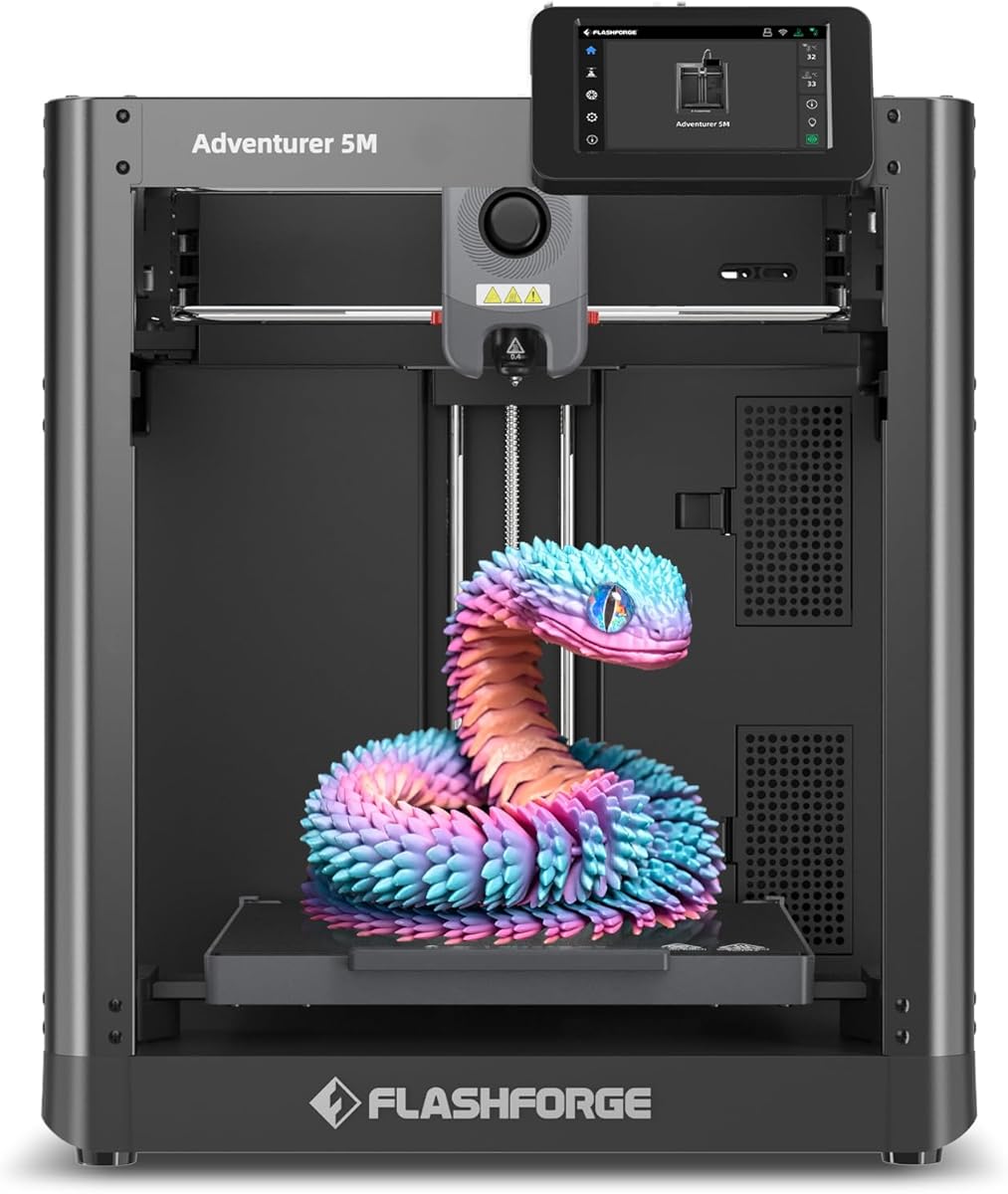
The Adventurer 5M offers high-speed CoreXY performance at a competitive price point, making it accessible for schools needing throughput without sacrificing quality.
We may earn a commission when you buy through this link, at no additional cost to you.
Automatic bed leveling and a high-flow extruder ensure consistent results, while real-time app monitoring lets teachers manage multiple devices remotely.
Its dual-sided PEI platform simplifies part removal, reducing frustration for students who are still learning the nuances of print adhesion.
This model is well-suited for environments where speed and efficiency are priorities and where ventilation is adequate for an open-frame machine.
High acceleration and travel speeds reduce print times, allowing more students to complete projects within typical class periods.
Flash Studio app support enables educators to monitor print status and adjust settings without needing to be physically present.
We may earn a commission when you buy through this link, at no additional cost to you.
The P1S combines enclosed stability with rapid calibration, making it a robust choice for schools using diverse filament types including engineering materials.
We may earn a commission when you buy through this link, at no additional cost to you.
Its user-friendly assembly process gets it running in just 15 minutes, while automatic bed leveling ensures that every first layer adheres correctly.
The enclosed body maintains consistent temperatures, which is critical for materials like ABS that require stable thermal environments to avoid warping.
For programs that need versatility and reliability, this printer offers a strong balance of speed, quality, and material compatibility.
An enclosed chamber keeps heat contained, enabling reliable prints with materials that would fail on open-frame machines.
Support for a wide range of filaments allows students to explore functional prototypes alongside artistic designs.
We may earn a commission when you buy through this link, at no additional cost to you.
The AD5M focuses on durability and ease of maintenance, with an all-metal CoreXY structure that supports reliable high-speed performance over time.
We may earn a commission when you buy through this link, at no additional cost to you.
Its power outage resume function is particularly useful for classrooms where unexpected interruptions can happen, ensuring students do not lose hours of work.
Quick-swap nozzles and a double-sided PEI plate simplify daily upkeep, allowing educators to maintain uptime without deep technical knowledge.
This printer is an excellent option for high-traffic environments where robustness and straightforward servicing are more important than enclosed stability.
Power failure recovery safeguards against lost prints, ensuring valuable lesson time is not wasted due to utility glitches.
Tool-free nozzle changes and a flexible bed make routine tasks simple, reducing downtime between student projects.
We may earn a commission when you buy through this link, at no additional cost to you.
The Ugee Funbox prioritizes safety with UL GREENGUARD certification and HEPA filtration, making it one of the safest options for younger users.
We may earn a commission when you buy through this link, at no additional cost to you.
Its AI-powered design tools and huge library of pre-tested models allow kids to create without needing advanced CAD skills or setup knowledge.
Live streaming via the built-in camera helps educators supervise print progress from afar, reducing the need for constant physical presence.
For home learning or elementary classrooms, this printer provides a secure, engaging entry point into 3D printing with minimal friction.
Enclosed body and certified low-emission materials protect students from fumes and hot surfaces during operation.
Voice and photo-to-print features inspire experimentation, helping students see how their ideas translate into physical objects.
We may earn a commission when you buy through this link, at no additional cost to you.
This variant of the Adventurer 5M emphasizes speed and reliability, featuring vibration compensation to reduce ghosting and ensure cleaner print surfaces.
We may earn a commission when you buy through this link, at no additional cost to you.
Filament run-out sensors and power-loss recovery protect against common failures, keeping classes on schedule even when materials run out unexpectedly.
With a 35-second heat-up time and 600mm/s speed, it delivers results quickly, which is valuable in tight academic schedules.
It is a solid choice for programs needing fast turnaround and straightforward operation without complex configuration requirements.
Vibration compensation and run-out detection minimize defects, ensuring that students see consistent results even at high speeds.
Fast heating and travel speeds mean more prints per session, allowing more students to participate actively in the class.
We may earn a commission when you buy through this link, at no additional cost to you.
The Snapmaker U1 introduces a 4-toolhead system that enables true multi-material and multi-color prints without manual purging or swapping.
We may earn a commission when you buy through this link, at no additional cost to you.
Its automatic calibration and 5-second tool changers make advanced techniques accessible to students who want to explore supports and complex assemblies.
Remote app control and AI monitoring add convenience for educators managing multiple printers, ensuring that problems are spotted early.
For advanced makerspaces where complex prototypes and engineering challenges are common, this system offers unmatched flexibility and performance.
Multi-material capabilities let students print rigid and flexible parts together, expanding what is possible with a single machine.
By minimizing purging during tool changes, the U1 conserves material, keeping project costs manageable in a classroom setting.
We may earn a commission when you buy through this link, at no additional cost to you.
The A1 Mini delivers the same auto-calibration and speed benefits as its larger sibling in a compact form, ideal for shared or constrained spaces.
We may earn a commission when you buy through this link, at no additional cost to you.
With the AMS lite included in the combo, students can experiment with multi-color printing without needing extra purchases or large footprints.
Pre-assembled design means less time on setup and more time printing, while noise cancellation ensures it remains unobtrusive in busy environments.
For schools needing multi-color capability on a smaller budget, this mini model strikes an excellent balance between features and affordability.
Despite its small size, the A1 Mini retains high-speed performance and reliable automation, making it suitable for any classroom.
The combo option provides an affordable entry into multi-color printing, allowing students to add complexity to designs without large costs.
We may earn a commission when you buy through this link, at no additional cost to you.
Selecting an educational 3D printer involves evaluating safety, ease of use, material support, and software integration to match your teaching environment.
Look for printers with UL GREENGUARD or equivalent certifications to ensure low emissions and safe operation in enclosed learning spaces.
Enclosed bodies with anti-pinch doors and cool-touch exteriors protect younger users from burns and moving parts during active projects.
Automatic bed leveling and auto-calibration reduce downtime and allow students to focus on design rather than troubleshooting hardware.
Pre-assembled units minimize initial setup time so classes can start printing within minutes instead of spending hours on configuration.
Integrated AI tools, model libraries, and guided STEM modules transform a printer into a curriculum-aligned learning platform.
Choose printers that support popular slicers and offer cloud features to help students collaborate and share projects across devices.
Ensure the printer supports PLA and PETG at minimum, with options for TPU, ABS, or ASA if you plan to teach engineering materials.
Multi-material or multi-color capabilities add creative depth but should match the budget and safety requirements of your classroom.
Select a build volume that fits your project needs without wasting space; compact models suit individual student work while larger ones support team projects.
Higher print speeds increase throughput in busy labs, but verify they do not compromise part quality or reliability.
WiFi and app control enable remote monitoring, which is invaluable when managing multiple printers or supervising students from a central location.
Offline modes and SD card support provide flexibility in environments with limited network access or stricter data security policies.
Quick-swap nozzles and power-loss recovery features reduce maintenance headaches and protect student work from unexpected interruptions.
Durable frames and reliable motors ensure that the printer survives frequent use over multiple academic years.
Begin by powering on the machine and letting it calibrate itself before loading filament; avoid forcing manual adjustments unless instructed.
Use the manufacturer's recommended slicing software or cloud tools to prepare models, ensuring settings match the filament type and size.
Perform regular maintenance such as cleaning the build plate, checking nozzle health, and replacing filters to maintain consistent print quality and safety.
Educational printers should be safe with certifications like UL GREENGUARD, have automatic calibration to reduce downtime, and integrate with curricula through built-in models and tools.
Enclosed printers are ideal for materials like ABS but not strictly necessary for PLA. Choose based on the types of projects you plan to teach.
Modern systems automate filament changes and calibration, making multi-color printing accessible for students without requiring manual purging or swaps.
Build volume should align with project scale; compact printers suit individual exercises while larger beds support team projects and functional parts.
Many printers work with Cura, Simplify3D, or proprietary cloud apps that offer guided workflows, model libraries, and teacher controls.
Use models with remote monitoring via apps or web dashboards to track status, send jobs, and troubleshoot issues from a central location.
PLA and PETG are generally safest due to low emissions. Ensure the room has ventilation even with safer materials to maintain air quality.
Many educational printers include safety features and monitoring tools, but adult oversight is still recommended for younger students or new users.
Our top three picks offer a range of options, from the budget-friendly Entina Tina2C to the high-performance Bambu Lab P2S Combo, depending on your needs.
Prioritize safety, automation, and learning resources to ensure your printer supports student creativity without overwhelming educators with maintenance.
Always check current availability and support policies before buying since educational needs and manufacturer offerings can change throughout the year.