
HiLetgo 3pcs ESP8266 ESP-01
4.2Editor score
Compact ESP8266 wireless transceiver
Supports AP STA and AP+STA modes
Compatible with Arduino and NodeMCU
This guide compares the top Arduino WiFi Module options for 2026 to help you choose the right wireless connectivity solution for your embedded projects.
Choosing the right Arduino WiFi Module is essential for building connected projects that communicate seamlessly with networks and devices. Whether you need simple sensor data transmission or complex IoT integration, selecting a module with reliable range and ease of use ensures your projects succeed without frustrating connectivity issues.
We evaluated ten popular modules based on compatibility, performance, features, and user feedback to create this comprehensive list. Our analysis focuses on how well each option integrates with the Arduino ecosystem, supports standard protocols, and handles real-world applications ranging from smart home devices to industrial automation systems.
Each pick highlights specific strengths like dual core processing, built in antennas, or budget friendly pricing to match different project needs. Keep in mind that availability and pricing can change frequently so verify current details before purchasing to ensure you get the best value for your specific development requirements.
4.2Editor score

4.7Editor score

4.7Editor score
The following comparison table outlines key specifications for each module to help you quickly identify the best fit for your specific development needs and budget constraints.



The Arduino UNO R4 WiFi stands out as the top choice for advanced projects needing both processing power and integrated features. With a 4.7 rating from users, this board combines the Renesas RA4M1 microcontroller with the ESP32-S3 chip to deliver high-speed communication and real-time data handling capabilities.
We may earn a commission when you buy through this link, at no additional cost to you.
Its dual-core design allows you to handle wireless tasks on the ESP32-S3 while the RA4M1 manages main logic efficiently. The board includes a built-in 12×8 LED Matrix for immediate visual feedback, plus a 12-bit DAC and OP AMP for precise analog signal generation ideal for audio or sensor applications.
While the board is more expensive than basic modules, the included features like Qwiic connectors and CAN support justify the cost for complex systems. Users note that the USB-C port makes programming easier and the wireless stability is reliable for demanding IoT deployments.
If you are building a sophisticated IoT system or educational tool requiring visual outputs, this module is the definitive pick. It balances performance and convenience better than any other option reviewed.
The built-in 12×8 LED Matrix allows you to display status messages or data directly on the board without external components.
Support for CAN bus enables reliable real-time communication suitable for automotive or robotic control systems.
We may earn a commission when you buy through this link, at no additional cost to you.
This 3-pack of ESP8266 ESP-01 modules offers an affordable entry point for adding WiFi to Arduino projects. Users appreciate the proven reliability of the ESP8266 chip which handles wireless communication efficiently through a serial interface compatible with standard Arduino development tools.
We may earn a commission when you buy through this link, at no additional cost to you.
The module supports three operational modes including Access Point Station and combined modes giving you flexibility in how your device connects to networks. It is particularly useful for prototyping multiple sensors or creating small batch production units where cost savings are critical.
Keep in mind that the ESP-01 requires careful voltage management as it operates at 3.3 volts rather than 5 volts. You will also need a separate USB to serial adapter for programming which adds to the complexity compared to all-in-one boards.
For developers who need basic wireless connectivity without extra features this bundle provides excellent value. It is a reliable choice for simple data logging or remote control projects.
Support for AP and STA modes allows the module to act as a router or connect to existing networks easily.
The small size makes it easy to embed into custom enclosures or crowded circuit boards.
We may earn a commission when you buy through this link, at no additional cost to you.
The ESP8266 ESP-01S variant improves upon the original design with 4MB of flash memory and stronger signal capabilities. This extra storage allows for more complex firmware and data buffering making it suitable for projects that need to store temporary information locally.
We may earn a commission when you buy through this link, at no additional cost to you.
Reviewers highlight the improved antenna performance which often results in more stable connections compared to older ESP-01 models. It remains a budget-friendly option that integrates seamlessly into Arduino projects using the standard serial communication protocol.
Programmers must select the Generic ESP8266 Module board in the Arduino IDE to ensure compatibility and proper configuration. The module lacks onboard USB so you will need an external programmer but this design choice keeps the cost very low.
If you need a reliable WiFi module with more memory than the base model this is a solid mid-range pick. It bridges the gap between basic modules and full development boards effectively.
4MB flash memory supports larger libraries and allows storing local data like sensor logs.
Enhanced RF components provide better signal penetration through walls compared to standard units.
We may earn a commission when you buy through this link, at no additional cost to you.
This bulk pack of five ESP-01 modules provides ample stock for teams or multi-node sensor networks. Users find them reliable for basic Arduino communication tasks and appreciate that they support standard AT commands for quick configuration testing.
We may earn a commission when you buy through this link, at no additional cost to you.
The modules are designed to operate at 3.3 volts which aligns with the ESP8266 requirements but you must ensure your logic levels match to avoid damage. They are particularly useful in industrial control and smart grid applications where multiple nodes are common.
While these modules are small and efficient they demand attention to power stability and I/O voltage tolerance. Improper voltage can lead to instability so using level shifters when interfacing with 5V Arduinos is recommended for safety.
For those needing multiple modules for a distributed system this 5-pack offers a cost effective solution. It is a dependable choice for building scalable wireless sensor arrays.
Suitable for smart grids and industrial control systems requiring multiple reliable connection points.
Supports standard AT+ commands allowing easy testing and configuration without full code upload.
We may earn a commission when you buy through this link, at no additional cost to you.
These ESP32 dev boards deliver premium performance with dual-core processing running up to 240 MHz allowing complex multitasking without lag. Users highlight the convenience of USB-C for power and programming which aligns with modern device standards and simplifies cabling for new users.
We may earn a commission when you buy through this link, at no additional cost to you.
The inclusion of Bluetooth 4.2 alongside Wi-Fi enables versatile device pairing options for smart home automation. Over-the-Air update support means you can deploy firmware changes wirelessly saving time during the development cycle and deployment phases.
While the Bluetooth version is older than the latest 5.0 standard the overall performance and connectivity features make up for it. The boards include SPI I2C and UART interfaces making them versatile for connecting various sensors and actuators directly.
If you want a ready-to-use development board without soldering this 3-pack is a top-tier choice. It balances power features and ease of use perfectly for serious IoT projects.
The USB-C port ensures efficient power delivery and faster data transfer for sketch uploads.
Built-in power saving modes reduce energy consumption ideal for battery powered monitoring.
We may earn a commission when you buy through this link, at no additional cost to you.
The Arduino Nano ESP32 brings advanced capabilities to a compact form factor making it ideal for portable devices. Powered by the ESP32-S3 it offers Bluetooth 5.0 and MicroPython compatibility which appeals to developers seeking flexibility and easier scripting options.
We may earn a commission when you buy through this link, at no additional cost to you.
This board supports HID profiles allowing you to create custom keyboards or mice which opens up new possibilities for input devices. Users appreciate the improved power delivery through USB-C which ensures stable operation even during heavy wireless usage.
The version without headers requires soldering which may be challenging for absolute beginners but provides flexibility for custom board layouts. It remains an excellent choice for projects needing low latency wireless communication in a small package.
If you need a versatile Nano sized board with Python support this model stands out. It is perfect for wearable technology or custom control interfaces.
MicroPython compatibility allows for faster prototyping and interactive coding sessions on the board.
HID support enables the board to function as a keyboard or mouse for custom control solutions.
We may earn a commission when you buy through this link, at no additional cost to you.
This 4-pack offers reliable ESP8266 modules designed for repeated use in wearable electronics and sensor networks. Users note that the RF components are self-calibrated to ensure optimal performance which helps maintain consistent signal quality across multiple devices.
We may earn a commission when you buy through this link, at no additional cost to you.
The modules are made of high quality materials that withstand multiple reuse cycles during testing and prototyping phases. They fit well in home automation projects where simple connectivity is needed without complex processing requirements on the node itself.
While they lack extra features like USB or onboard LEDs they perform their core function of wireless transmission effectively. The simplicity allows for lightweight code implementation and reduced power consumption compared to more complex boards.
For bulk sensor deployment or educational kits this pack is a practical choice. It balances reliability and cost effectively for networked projects.
Self-calibrated RF modules ensure optimal performance across multiple nodes in a network.
Constructed from durable materials to support multiple reuse cycles during development.
We may earn a commission when you buy through this link, at no additional cost to you.
This bulk 5-pack features the ESP-01S variant with 4MB flash storage and DOUT protocol requirements for SPI configuration. Users value the ample storage for handling larger data sets and complex firmware without external memory chips.
We may earn a commission when you buy through this link, at no additional cost to you.
The baud rate is set to 115200 which is a standard speed for Arduino communication ensuring smooth data transfer between modules. It is specifically designed for Internet of Things applications where stable and persistent storage is beneficial.
Programmers must choose SPI MODE as DOUT when programming to avoid boot errors which is a key detail for smooth setup. The strict 3.3V voltage limit requires careful power management but ensures compatibility with standard microcontroller logic levels.
If you need multiple high-memory modules for large sensor arrays this bundle is excellent. It offers robust capabilities for advanced wireless development.
Standard 115200 baud rate ensures compatibility with most Arduino serial communication setups.
Requires specific SPI DOUT mode selection for successful firmware uploads and operation.
We may earn a commission when you buy through this link, at no additional cost to you.
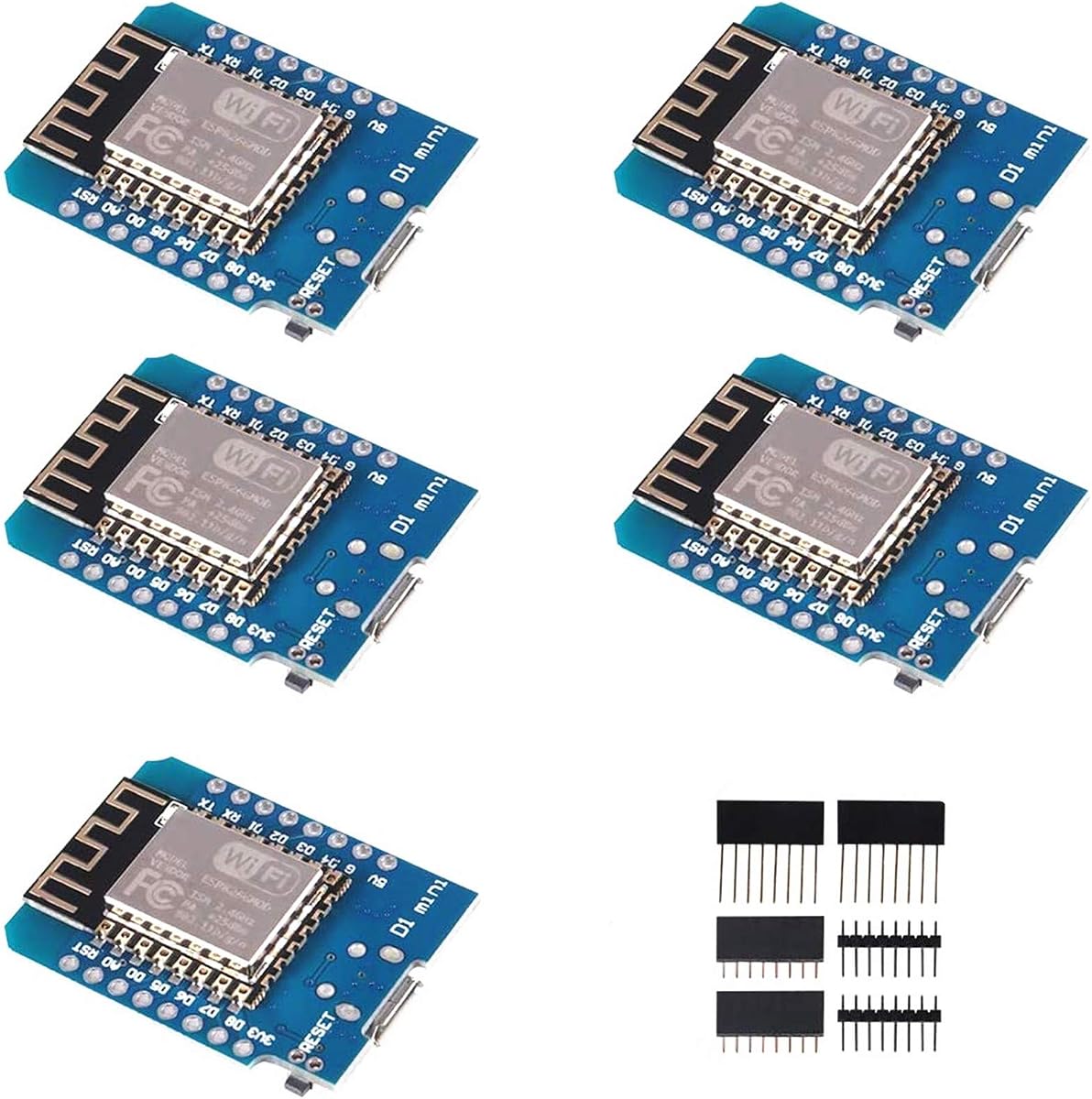
These mini development boards are based on the ESP-12F and offer full access to digital IO pins plus a single analog input. They feature a Micro USB connection for power and programming making them more user-friendly than bare modules for prototyping purposes.
We may earn a commission when you buy through this link, at no additional cost to you.
Each board includes a built-in switching power supply that handles voltage regulation allowing direct connection to 5V power sources without extra components. Users appreciate the compatibility with WeMos and NodeMcu libraries which speeds up development significantly.
The single analog input is limited to 3.2V max which is typical for ESP8266 chips but requires a voltage divider for higher signals. Despite this limitation the rich set of digital features makes these boards very versatile for sensor integration.
For makers who want a full board without soldering bare modules these packs are ideal. They simplify the wiring process and improve project stability.
Onboard switching power supply allows direct connection to 5V sources without extra regulators.
Provides 11 digital pins for interrupt PWM I2C and single wire communication tasks.
We may earn a commission when you buy through this link, at no additional cost to you.
This 10-pack provides a large supply of ESP-01 modules ideal for extensive IoT networks or educational workshops. Users report high satisfaction with the on-board processing capabilities that allow efficient execution of complex tasks and algorithms directly on the chip.
We may earn a commission when you buy through this link, at no additional cost to you.
The modules offer ample storage for data retention and retrieval ensuring that operations remain uninterrupted even during network fluctuations. They support AP STA and AP+STA modes giving you multiple ways to configure wireless communication for various project needs.
While they are basic in form factor their robust performance and high ratings make them reliable for standard transceiver tasks. The quantity makes them perfect for scaling up projects or sharing among teams without worrying about running out of stock.
If you need a large volume of proven wireless modules this bundle is highly recommended. It offers excellent scalability for growing smart home or industrial systems.
Robust on-board processing allows efficient execution of complex tasks and algorithms locally.
Support for AP STA and combined modes provides versatile networking options for diverse scenarios.
We may earn a commission when you buy through this link, at no additional cost to you.
Selecting the right module depends on your project requirements budget and technical skills. This guide outlines the most important factors to consider.
Modern projects often require more than just basic connectivity so consider boards with dual-core processors like the ESP32-S3 for multitasking. Higher clock speeds such as 240 MHz help with data processing and edge computing tasks.
Look for modules that balance processing needs with power consumption to ensure your device runs efficiently.
Check if the module supports the latest wireless standards like Bluetooth 5.0 or modern Wi-Fi bands for better range and speed. Some boards also include CAN bus support which is essential for automotive or industrial control systems.
Prioritize boards that offer the specific protocols your application requires to avoid retrofitting later.
Modules with USB-C ports simplify the development process by eliminating the need for separate FTDI adapters. This modern interface ensures faster uploads and better power delivery stability during testing phases.
Choose options with built-in interfaces to streamline your workflow and reduce hardware clutter.
For applications that store logs or handle large firmware images consider modules with at least 4MB of flash memory. This capacity allows for more complex code and local data buffering which improves reliability.
Higher storage options are valuable for projects needing persistent data handling without external chips.
Nano sized boards are ideal for wearables or portable devices where space is constrained. Larger boards like the UNO R4 offer more features but take up more room in your enclosure.
Match the physical dimensions to your final product design to ensure fit and functionality.
Some boards include LED matrices DACs or specific support for custom input devices which adds versatility without external components. These features can simplify your circuit design and reduce wiring complexity.
Evaluate which built-in features add value to your specific project needs before purchasing.
For battery powered devices look for power saving modes that reduce energy use during idle periods. Efficient voltage regulation and low power states are critical for long-term deployment.
Select modules with robust power management features to maximize battery life and reliability.
If you are building multiple units or prototyping many nodes consider buying in bulk packs to reduce per-unit costs. Budget friendly options like ESP8266 modules can save significant money for large scale deployments.
Balance the initial cost with long-term value by checking compatibility and feature sets carefully.
Connect your module securely to a power source ensuring voltage matches the 3.3V requirements to avoid damage. For modules without USB use a dedicated serial adapter and verify pin connections before powering on.
Use the Arduino IDE to install necessary board support packages and select the correct board type like Generic ESP8266 Module. Upload your code and monitor the serial output to debug connectivity issues effectively.
Protect your module from physical stress and static electricity by storing it in anti-static bags when not in use. Regularly check connections and firmware updates to maintain reliable wireless performance over time.
Yes many of these modules can work with a standard Arduino Uno via serial communication though you will need logic level shifters. Modules like the ESP-01 are great add-ons while boards like ESP32 can replace the Arduino entirely.
The ESP32 based boards offer excellent power-saving features including deep sleep modes that reduce consumption to microamps. Look for boards that support dynamic clock scaling to further optimize energy use.
Many modern modules like the ESP32-S3 boards support Bluetooth 5.0 or 4.2 for device pairing. Older ESP8266 modules typically only support Wi-Fi connectivity.
Range varies based on environment and antenna design but typically you can expect 30 to 100 meters outdoors. Using an external antenna can extend this significantly compared to onboard PCB antennas.
Use the Arduino IDE to install board support packages and select the correct board type. For standalone modules you need a USB to serial adapter to upload code directly.
Newer boards like the Arduino Nano ESP32 officially support MicroPython allowing for easier scripting. Most ESP32 boards also have community ports available for Python programming.
A stable 3.3V power supply is critical for ESP8266 and ESP32 modules to avoid brownouts. Ensure your source can provide sufficient current especially when Wi-Fi transmits data.
Some modules like the ESP-01 benefit from a capacitor near the power pin to prevent voltage drops during transmission. Boards with built-in regulators are usually stable without extra components.
We highlighted the Arduino UNO R4 WiFi for advanced users needing built-in features and the ELEGOO ESP32 boards for premium performance and versatility.
Prioritize boards that match your power needs and programming skills to ensure a smooth development experience from start to finish.
Check current availability and prices regularly as the electronics market changes quickly and these options may vary in stock.