
Acxico 3Pcs Mini Micro N20
4.6Editor score
Full metal gearbox
Low voltage range
Compact size
This guide compares the top DC motors for robots including gear ratios torque voltage and encoder options to help you select the right motor for your project.
Finding the right power source is essential for building reliable autonomous machines. DC motors provide the speed and torque needed for wheels arms and joints in robotic systems.
We analyzed ten top rated options based on gear types voltage ranges and build quality. This list covers mini hobby motors and high torque geared units for diverse projects.
Each pick highlights key specs and ideal applications for your build. Remember that stock and pricing can change so verify details before ordering your components today.
4.6Editor score

4.7Editor score

4.6Editor score
The following table offers a side-by-side comparison of all ten selected motors. Review the voltage specs gear types and shaft details to find the best match for your robotic design needs.



This motor set stands out for its all metal construction and precise Hall encoder feedback. With a 4.7 rating it offers reliable performance for smart robot and vehicle projects requiring accurate speed control.
We may earn a commission when you buy through this link, at no additional cost to you.
The 1:90 reduction ratio delivers high torque suitable for heavy loads while the AB-Phase Hall encoder enables real time speed and position measurement. The PH2.0 anti-reverse interface simplifies wiring and the LED shows operational status clearly.
While the price is higher than basic TT motors the durability and control capabilities justify the cost for serious builders. The encoder wiring requires attention to voltage limits but offers significant advantages for automation tasks.
Advanced robotics hobbyists and professional developers should choose this for projects needing closed loop control. Its robust design ensures long service life even under demanding operating conditions.
The integrated encoder allows accurate speed regulation essential for balanced robots and autonomous navigation tasks.
Metal gears and shafts handle high torque loads without wear extending the motor lifespan significantly compared to plastic units.
We may earn a commission when you buy through this link, at no additional cost to you.
This pack offers an affordable entry point for hobbyists needing reliable small motors. Rated 4.6 it features full metal gearboxes in a compact micro form ideal for DIY robot cars and small prototypes.
We may earn a commission when you buy through this link, at no additional cost to you.
The slow speed full metal gearbox design ensures durability and consistent performance at low voltages. With D type shafts and a simple package these units integrate easily into tight spaces without extra hardware.
Torque is limited compared to larger geared motors so these suit light duty applications. The low voltage requirement matches battery powered educational kits well without needing complex power supplies.
Beginners and budget constrained builders will find this value unmatched for basic movement tasks. Keep in mind voltage limits when designing circuits to avoid overheating or premature failure.
Metal gears provide better durability than plastic alternatives at a low price point for small scale projects.
The small form factor and included accessories make mounting straightforward for tight robot chassis designs.
We may earn a commission when you buy through this link, at no additional cost to you.
This motor delivers industrial strength torque and voltage flexibility ideal for demanding robotic applications. Its 4.6 rating reflects consistent performance in rotating tables door locks and heavy load moving systems.
We may earn a commission when you buy through this link, at no additional cost to you.
The 90kg.cm torque output handles significant loads while the wide 6V to 22V range accommodates various power sources. Metal gearing ensures longevity under stress and the D shaft provides secure mechanical connection.
Its physical size exceeds typical hobby motors requiring careful chassis planning and robust mounting. Higher voltage needs mean battery packs or supplies must match specifications for safe operation.
Industrial developers and professional robotics teams should consider this for high torque needs. The quality and power justify the premium cost for reliable continuous duty performance.
The 90kg.cm torque enables lifting and moving heavy components essential for advanced robotic arms and automation.
Operating across 6V to 22V allows adaptation to different power systems without requiring multiple motor types.
We may earn a commission when you buy through this link, at no additional cost to you.
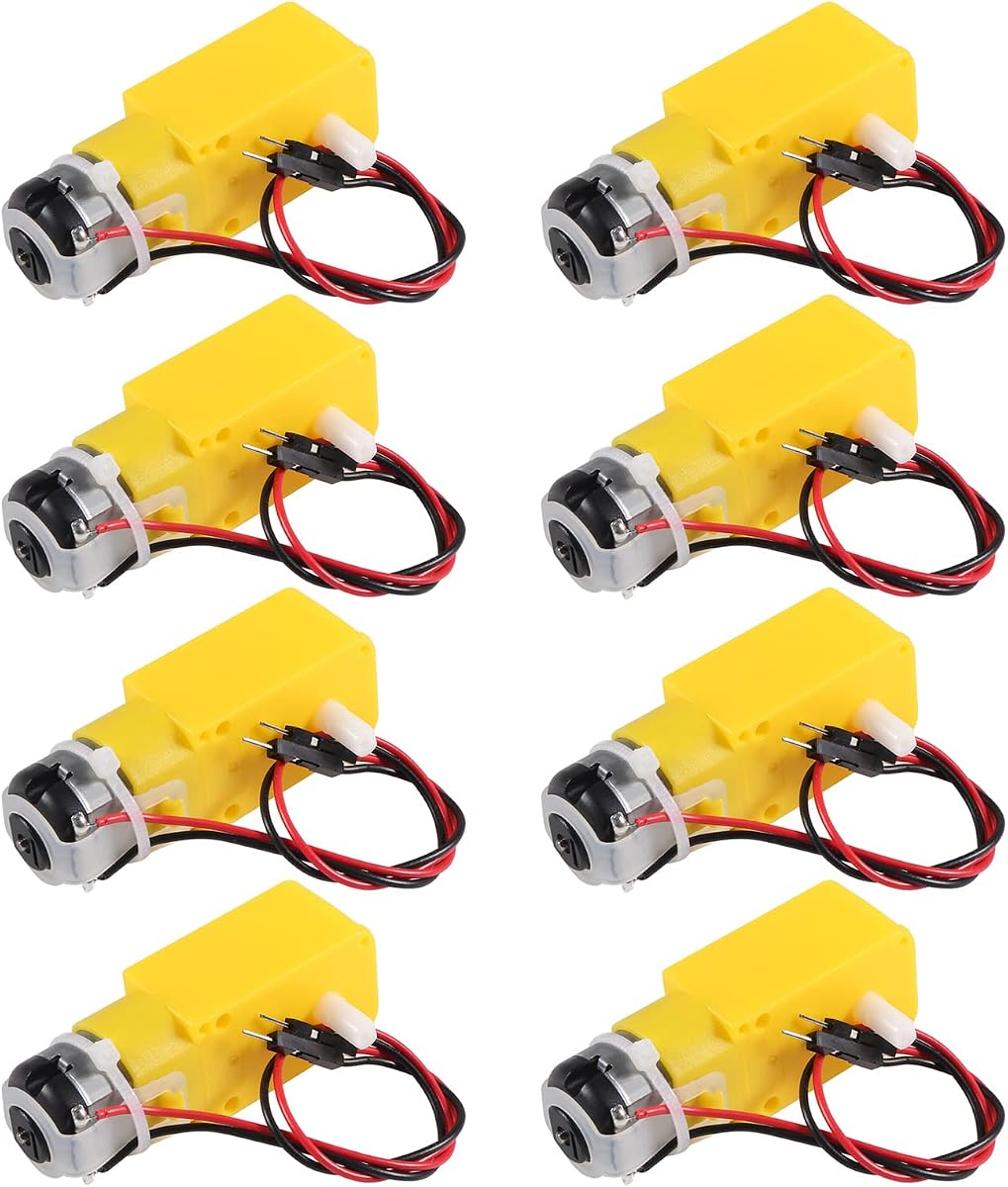
This large pack provides eight motors perfect for multiple builds or team projects. With a 4.5 rating it delivers dependable performance for smart cars and educational robotics competitions.
We may earn a commission when you buy through this link, at no additional cost to you.
The 1:48 gear ratio yields balanced speed and torque for standard wheel setups. Wires terminate in male 2.54mm connectors for easy breadboard plugging and the set includes four wheels.
Lack of encoders limits precise speed control but suits open loop navigation well. The voltage range matches most hobby boards making integration simple without level shifting circuits.
Educators and students needing bulk motors will appreciate the cost efficiency. It supports rapid prototyping while keeping wiring and assembly straightforward for beginners.
Standard connectors and voltage make these ideal for classroom robotics projects and learning experiments.
Eight units allow testing multiple designs or building fleets without repeated purchasing and shipping costs.
We may earn a commission when you buy through this link, at no additional cost to you.
This unit combines encoder feedback with metal gearing and a bracket for versatile use. It holds a 4.4 rating for reliable performance in smart car models and robotics tasks needing speed control.
We may earn a commission when you buy through this link, at no additional cost to you.
Magnetic enclosed structure reduces weight while pure copper coils and metal gears improve efficiency and lifespan. The included bracket and wheel kit simplify mounting and wheel attachment.
Voltage is fixed at 12V which limits flexibility but simplifies design. Torque is moderate so heavy loads may require dual motor setups for adequate power.
Robotics makers wanting ready to use kits will find this convenient. The encoder and bracket save time on assembly and testing phases.
Included wheels and bracket allow quick deployment without sourcing extra mounting parts or tires separately.
Built-in encoder provides speed data for closed loop control improving accuracy and stability in motion.
We may earn a commission when you buy through this link, at no additional cost to you.
This motor delivers substantial torque for heavy duty applications like Measuring devices and balance cars. Rated 4.6 it features durable metal gears and a reliable D-shaped shaft for secure wheel mounting.
We may earn a commission when you buy through this link, at no additional cost to you.
The 70:1 reduction ratio provides strong low speed torque suitable for lifting and moving objects. A metal mounting bracket ensures stability during operation and simplifies chassis integration.
Weight may be higher than plastic units requiring structural consideration in lightweight designs. The dual voltage option gives flexibility for battery or adapter power systems.
Advanced hobbyists building robust platforms should consider this motor for its strength. The included hardware reduces assembly time and ensures secure mechanical connection.
The 70:1 gear ratio enables smooth movement of heavy loads at controlled speeds ideal for robots carrying equipment.
Included metal bracket provides firm attachment points ensuring motor stability during high torque operations.
We may earn a commission when you buy through this link, at no additional cost to you.
This pair boasts a perfect 5.0 rating for quiet and powerful performance in RC and robotic builds. The double shaft design and copper rotor ensure efficient power delivery with minimal noise.
We may earn a commission when you buy through this link, at no additional cost to you.
All-metal gears resist wear under stress while the secure D-shaped shaft prevents wheel slippage. The compact size fits standard chassis designs and the copper rotor boosts torque by thirty percent.
Voltage is limited to 6-12V which restricts battery options but ensures safe operation. The dual shaft allows connecting components on both ends adding mechanical versatility.
Builders prioritizing quiet operation and torque should choose this motor. Its high rating reflects proven reliability in demanding craft and electronics projects.
Connecting wheels or gears on both ends expands mechanical options for complex drive trains and robotics.
Precision metal gears and balanced rotors reduce noise making these suitable for quiet environments.
We may earn a commission when you buy through this link, at no additional cost to you.
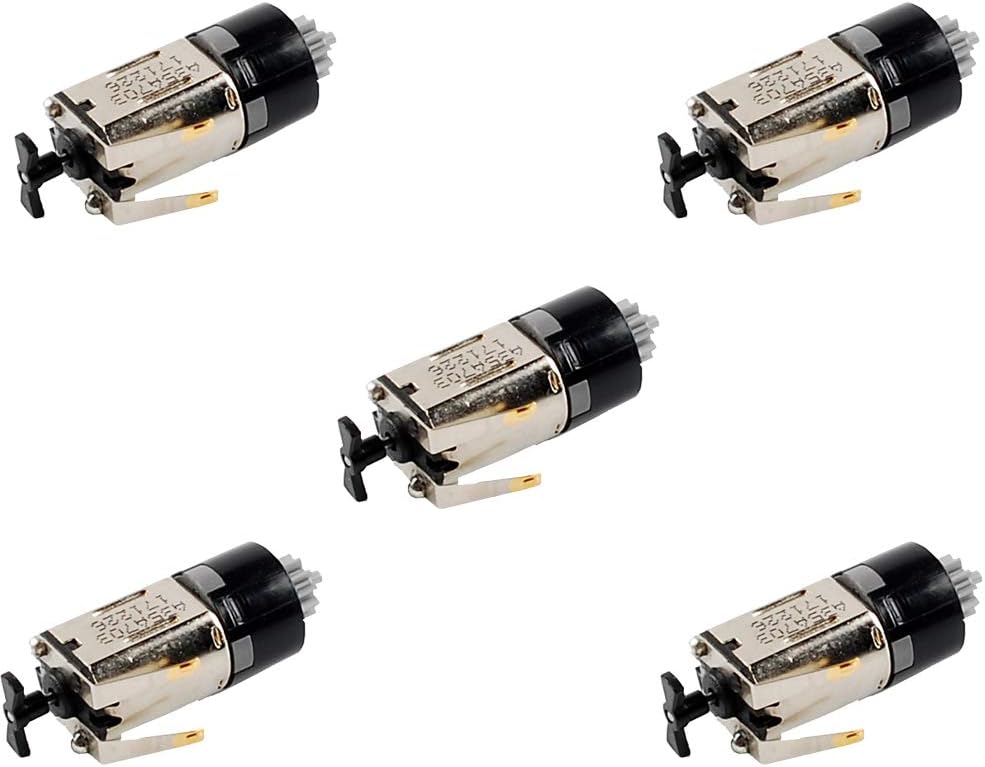
This pack of six Type 130 motors offers extreme compactness and high speed for micro projects. Rated 4.2 they suit fans, brush bots, and lightweight solar powered vehicles needing minimal power draw.
We may earn a commission when you buy through this link, at no additional cost to you.
The voltage range down to 1.5V allows single cell battery operation. Wire leads are pre-attached for quick connection but lack external gearboxes for torque multiplication.
High RPM suits fans and whirling devices but limits load carrying capability. Users must add external gearing for torque if required in their build.
Small scale hobbyists and micro robotics enthusiasts will find these ideal. Their simplicity and low profile enable unique designs not possible with bulkier motors.
Miniature size allows integration into tiny chassis and wearable electronics where space is limited.
1.5V operation enables use with common batteries without step-up converters for portable projects.
We may earn a commission when you buy through this link, at no additional cost to you.
This pack features compact planetary reducers delivering high torque at low speed for micro robotics. Rated 4.4 the units suit small devices requiring controlled motion like robotic grippers or slow wheels.
We may earn a commission when you buy through this link, at no additional cost to you.
The planetary design increases torque efficiently without large external gearboxes. Operating at 3V it matches common microcontroller power supplies and reduces wiring complexity significantly.
Speed is restricted around 110 rpm which limits fast movement applications. The fixed voltage simplifies design but limits flexibility if higher voltage is needed.
Designers needing compact high torque solutions should consider this set. The planetary gear integration simplifies mechanical assembly in tight spaces.
Integrated planetary gears multiply torque while keeping the motor footprint minimal for compact robotic joints.
Three volt operation reduces power management needs and matches small battery configurations common in micro projects.
We may earn a commission when you buy through this link, at no additional cost to you.
This versatile unit offers high speed output and wide voltage range for RC and robot builds. Rated 4.4 it serves well for replacements in Power Wheels and hobby models needing strong performance.
We may earn a commission when you buy through this link, at no additional cost to you.
The small shaft allows custom gear fitment and high RPM enables fast movement. No gearbox keeps weight low but adds complexity for torque needs without external reduction.
Mounting hardware is not included so custom brackets or glue may be required. The low cost makes it practical for testing or temporary prototypes before upgrading.
Hobbyists repairing or upgrading RC vehicles will find this motor suitable. Its speed and voltage flexibility support diverse hobby applications and custom projects.
Twelve thousand RPM allows rapid motion in lightweight toys and fast response RC models.
Small shaft enables custom gear selection and adaptation to unique mechanical assemblies.
We may earn a commission when you buy through this link, at no additional cost to you.
Selecting the right DC motor requires evaluating several technical factors to match your project needs. This guide explains key criteria to simplify your decision.
Check that the motor voltage matches your battery or power supply. Too low voltage reduces torque while too high risks overheating and damage. Many motors support a range such as 3V to 12V for flexibility.
Always verify voltage compatibility to ensure safe and efficient operation.
Torque determines how much load the motor can move while speed defines movement rate. Gearboxes reduce speed but increase torque for heavy lifting. Higher ratios suit slow strong moves and lower ratios suit fast light moves.
Choose torque and speed based on your robot's weight and motion needs.
Metal gearboxes offer durability and better heat dissipation than plastic. Planetary gears provide compact torque multiplication while spur gears are common and affordable. Select the gear type based on load and size constraints.
Metal gears are recommended for long term reliability and high torque.
Encoders allow precise speed and position control essential for balancing and navigation. Hall encoders are common for robotics while optical ones provide higher resolution. Not all motors include encoders so check product specs carefully.
Use encoders when closed loop control and accuracy are critical.
Shaft type and diameter affect wheel or gear fitment. D shaped shafts prevent slipping better than round ones. Mounting brackets simplify installation and stability during operation. Ensure dimensions fit your chassis design.
Confirm shaft and mounting specs to avoid assembly issues later.
Motor dimensions must fit within your robot chassis without interfering. Weight impacts overall balance and battery life. Compact motors suit small designs but may have less torque. Consider trade-offs carefully.
Select size and weight that balance performance and fit.
Pre-attached wires with connectors save assembly time. Check wire length and plug types match your controllers. Some motors offer reversible wiring for direction control. Secure connections prevent signal loss and shorts.
Verify wiring details to ensure smooth integration with electronics.
Different motors excel in specific uses such as slow heavy lifts or fast light motion. Match motor features to your project goals. Educational kits need simple units while industrial builds need robust power.
Choose motors designed for your specific application and task.
Start by connecting motor terminals securely to your controller or driver. Use appropriate voltage and avoid reversing polarity without a driver circuit. Test briefly to confirm direction and smooth rotation.
Keep motors clean and free from dust or debris. Ensure proper mounting to prevent vibration damage. Avoid operating beyond rated speeds or loads to extend life.
Regularly check wires and connectors for wear or looseness. Lubricate shafts lightly if allowed by design. Monitor temperature during extended use and allow cool downs between runs.
Use a voltage within the motor's rated range usually marked on the label. Most hobby motors work between 3V and 12V. Exceeding rated voltage risks overheating while lower voltage reduces performance. Always match your power source to motor specs for safety.
Reverse polarity by swapping the two power leads on the motor terminals. Many motor drivers include reverse functions controlled by code. Ensure your controller supports reversing or use a DPDT switch manually. Test gently to confirm direction change.
Not always. Encoders are essential for precise control and balancing robots. Simple open loop tasks like basic wheels do not need encoders. If accurate speed or position matters choose motors with built-in encoders.
Yes but ensure your controller handles the total current draw. Motors add current draw so calculate sum for all units. Use motor drivers with multiple channels for independent control. Avoid overloading power supplies or circuits.
Overheating happens when the motor is overloaded or run at high voltages. Ensure the voltage matches specs and load is within torque limits. Check mounting for friction and allow air flow. Let motors cool between extended runs.
Metal gearbox motors offer better durability and torque than plastic. Planetary gears are compact with high torque ratios. Choose gear ratio based on desired speed and load. Metal is preferred for long term reliability.
Use the included mounting brackets or custom holes matching the motor dimensions. Secure bolts tightly to avoid vibration. Align shafts carefully to prevent binding. Proper mounting ensures stability and protects motor bearings.
Yes but they usually require motor drivers because controllers output low current. Use H bridge drivers for direction and speed control. Connect drivers to controller pins and supply separate power to motors. Check voltage compatibility for all components.
The top three picks offer standout features for different needs from precision control to heavy torque. Each option delivers value depending on project requirements and budget.
Prioritize voltage range and torque based on your load and speed goals. Encoders add control but increase cost so decide if precision is necessary for your build.
Always verify current specs and prices before ordering to ensure availability. These motors represent solid choices to power your next robotic creation successfully.