
ASRock Intel Arc Pro B60 Creator 24GB
3.9Editor score
24GB GDDR6 Memory
Intel Xe2-HPG Architecture
PCIe 5.0 Support
This guide compares the top 10 GPUs for LLM workloads including memory capacity, bandwidth, and architecture to help you choose the best hardware for local AI
Choosing the right graphics processing unit is critical for running large language models locally. You need massive VRAM capacity and high bandwidth to handle complex neural networks without bottlenecks.
We analyzed ten leading GPUs designed for AI workloads ranging from consumer cards to enterprise accelerators. Each option was evaluated on architecture memory specs and suitability for LLM tasks.
Every pick highlights specific strengths for AI inference and training. Note that market prices fluctuate frequently so verify current costs before making your final purchasing decision today.
3.9Editor score

3.6Editor score

This table provides a quick side-by-side comparison of all ten graphics cards reviewed in this guide allowing you to assess key specifications at a glance.




The GIGABYTE GeForce RTX 5080 Gaming OC 16G stands out as a top choice for enthusiasts running local LLM inference. It combines the latest NVIDIA Blackwell architecture with 16GB of fast GDDR7 memory offering solid performance for mid-sized models.
We may earn a commission when you buy through this link, at no additional cost to you.
Its standout quality lies in the memory bandwidth and cooling efficiency. The 256-bit bus interface paired with GDDR7 ensures data flows quickly to the cores reducing latency during token generation. The WINDFORCE cooling system keeps thermal throttling at bay even under sustained AI workloads.
While 16GB is sufficient for many popular open-source models it may struggle with massive multi-parameter networks without quantization. The requirement for a specific 12V-2×6 power connector also means you must check your power supply compatibility before installing this card.
This GPU is ideal for researchers and developers who need a balance of cost and performance for local inference tasks. It delivers reliable results for text generation and moderate fine-tuning workloads making it a versatile choice for home lab setups.
The GDDR7 memory significantly increases data throughput compared to previous generations allowing faster processing of complex language model layers.
The WINDFORCE cooling system uses multiple fans to dissipate heat effectively ensuring consistent performance during long inference sessions.
We may earn a commission when you buy through this link, at no additional cost to you.
The ASRock Intel Arc Pro B60 Creator 24GB offers an impressive amount of memory for its price making it a compelling budget option for LLM enthusiasts. With 24GB of GDDR6 it can handle larger models that would overflow smaller cards.
We may earn a commission when you buy through this link, at no additional cost to you.
Its key strength is the VRAM capacity which allows running models like Llama 3 70B with quantization. The Intel Xe2-HPG architecture provides dedicated AI engines that accelerate inference tasks efficiently. It is also optimized for Linux environments where multi-GPU scaling is common.
Intel AI software support is improving but still lags behind NVIDIA in some toolchains. The single blower fan might be noisy in a quiet desktop environment. You should verify driver compatibility with your specific AI framework before purchasing.
This card is perfect for users on a tight budget who prioritize memory size over raw speed. It enables access to large language models locally without the high cost of enterprise-grade hardware making AI research more accessible.
With 24GB of VRAM you can load significantly larger models compared to standard 12GB or 16GB cards without relying on system RAM.
The card supports scalable multi-GPU configurations on Linux allowing you to stack multiple units for increased total memory capacity.
We may earn a commission when you buy through this link, at no additional cost to you.
The ASRock Radeon AI PRO R9700 Creator 32GB is engineered for professional workflows requiring substantial memory and reliability. It features 32GB of GDDR6 memory which is ideal for handling large language models and complex generative tasks locally.
We may earn a commission when you buy through this link, at no additional cost to you.
Its standout qualities include the professional blower design which exhausts heat directly out of the chassis crucial for multi-GPU server builds. The vapor chamber heatsink ensures stable performance under sustained loads without thermal throttling. The RDNA 4 architecture includes dedicated AI accelerators for better throughput.
While powerful this card comes at a premium price point compared to gaming equivalents. Compatibility with specific AI software may require careful driver setup. The 2-slot form factor is compact but requires adequate airflow in the case.
This GPU is best suited for creators and researchers who need consistent performance and high VRAM capacity. It bridges the gap between consumer and enterprise hardware offering professional reliability for intensive LLM workloads.
The blower cooler design is optimized for multi-GPU setups ensuring heat is expelled efficiently to maintain high clocks.
Third Gen Ray Tracing and dedicated AI Accelerators provide enhanced performance for compute-intensive AI and rendering tasks.
We may earn a commission when you buy through this link, at no additional cost to you.
The GIGABYTE Radeon RX 9070 XT Gaming OC 16G delivers strong performance for general compute tasks including LLM inference. It boasts 16GB of GDDR6 memory and PCIe 5.0 support providing a solid platform for modern workloads.
We may earn a commission when you buy through this link, at no additional cost to you.
Its key strength is the WINDFORCE cooling system with Hawk Fans ensuring the card runs cool and quiet. The server-grade thermal conductive gel helps transfer heat efficiently. This card offers high clock speeds which benefit single-threaded tasks.
It is primarily a gaming card so AI specific features are less developed than on professional models. The 16GB memory is adequate for many models but might limit very large fine-tuning tasks. RGB lighting may not be desired in server racks.
This GPU is a great choice for users who want a single card for both gaming and AI experimentation. It balances cost and performance effectively making it accessible for hobbyists exploring local LLMs.
The WINDFORCE system with server-grade thermal gel keeps temperatures low during extended periods of high GPU usage.
High boost clocks ensure responsive performance across a variety of computing tasks from gaming to AI inference.
We may earn a commission when you buy through this link, at no additional cost to you.
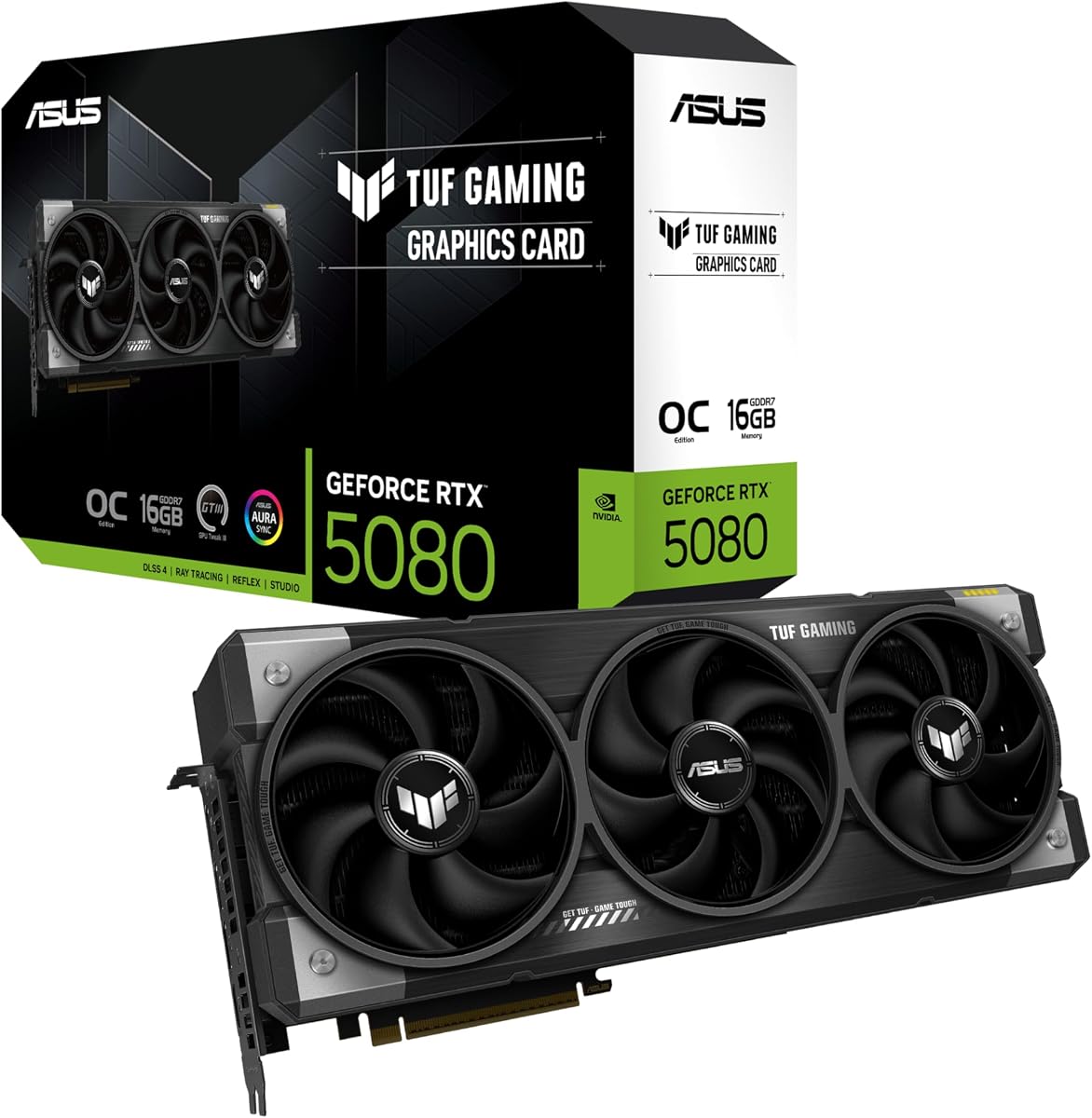
The ASUS TUF Gaming GeForce RTX 5080 16GB GDDR7 OC Edition is built for durability and reliability in demanding environments. It features the NVIDIA Blackwell architecture with 16GB of high-speed GDDR7 memory for efficient AI processing.
We may earn a commission when you buy through this link, at no additional cost to you.
Its standout qualities include military-grade components and a protective PCB coating that guards against moisture and dust. The phase-change thermal pad ensures long-term thermal performance without drying out. Auto-Extreme manufacturing enhances reliability.
This card is physically large requiring 3.6 slots and significant clearance. It also demands a minimum 850W PSU with specific connectors. The high power consumption must be considered when building a balanced system.
Ideal for professional users seeking longevity and robust performance this GPU offers peace of mind for heavy workloads. It is well-suited for workstations where stability over years of use is a priority.
Military grade components and protective PCB coating extend the lifespan of the card in diverse environmental conditions.
Phase-change thermal pads maintain consistent thermal transfer over time outlasting traditional thermal paste under heavy loads.
We may earn a commission when you buy through this link, at no additional cost to you.
The ASUS Turbo Radeon AI PRO R9700 32GB is explicitly built for running LLMs locally. It delivers 32GB of VRAM allowing large language and multi-modal models to run without needing to offload data to system RAM.
We may earn a commission when you buy through this link, at no additional cost to you.
Key strengths include multi-GPU scaling support for local AI clusters and 128 AI Accelerators for high TOPS performance. The wave-pattern shroud reduces memory temperature by up to 16 percent ensuring steady clocks during long training runs.
This card is specialized for AI workflows which might limit its versatility for other tasks compared to gaming cards. The higher cost reflects its professional positioning. Ensure your power supply can handle multiple units if you plan to scale.
Perfect for building local AI clusters this GPU provides the necessary infrastructure for serious experimentation. It is an excellent choice for researchers who need reliable high-memory hardware for distributed inference.
Designed with multi-GPU scaling in mind this card allows you to combine multiple GPUs for massive memory pools.
The wave-pattern design specifically targets memory temperatures to prevent throttling during intensive AI training cycles.
We may earn a commission when you buy through this link, at no additional cost to you.
The ASUS Dual GeForce RTX 5060 Ti 16GB GDDR7 OC Edition offers a compact solution for LLM inference. With 16GB of GDDR7 in a 2.5-slot form factor it fits easily into smaller cases while providing decent memory.
We may earn a commission when you buy through this link, at no additional cost to you.
Its standout quality is the balance of size and capability. The Axial-tech fan design ensures adequate cooling despite the smaller size. Dual BIOS allows toggling between quiet and performance profiles giving flexibility for different environments.
While compact the card may not deliver the same raw throughput as larger high-end models. It is best suited for light to moderate AI tasks. The 0dB technology is beneficial for noise-sensitive home offices.
This GPU is ideal for users with space constraints who still need modern GPU performance. It is a practical choice for small form factor builds intended for occasional AI experimentation.
The 2.5-slot design maximizes compatibility with smaller enclosures making it a great option for compact workstations.
Dual BIOS lets you choose between performance and quiet modes depending on your current workload needs.
We may earn a commission when you buy through this link, at no additional cost to you.
The Tesla L40S 48GB AI HPC Graphics Accelerator is designed for high-performance computing environments requiring substantial memory. With 48GB of VRAM it can handle extremely large models without compression.
We may earn a commission when you buy through this link, at no additional cost to you.
Its key strength is the massive memory capacity which is critical for enterprise LLM deployments. It is built for reliability in server racks with professional support options. It excels in parallel compute tasks typical of large-scale AI training.
This accelerator is expensive and requires specific server infrastructure to operate effectively. It is not designed for desktop use. You need adequate cooling and power systems to support this hardware properly.
Best for enterprise teams needing reliable high-memory hardware for large models this GPU ensures stability. It is a robust choice for organizations scaling AI operations across multiple workloads.
With 48GB of VRAM this accelerator allows loading huge models directly without needing complex offloading strategies.
Built for server environments it offers long-term stability and professional support for critical business applications.
We may earn a commission when you buy through this link, at no additional cost to you.
The NVlDlA RTX PRO 6000 Blackwell max-Q Workstation Ed. 96GB GDDR7 ECC GPU is a monster for local generative AI. It packs 96GB of ECC memory which eliminates VRAM bottlenecks for heavy open-source LLMs.
We may earn a commission when you buy through this link, at no additional cost to you.
Its standout qualities include the 512-bit bus width and 3,511 TOPS AI performance. The Max-Q design caps power consumption at 300W for thermal management in multi-GPU desktops. It supports agentic workflows and data science tasks.
This card is incredibly expensive and comes in bulk packaging which might not suit individual buyers. It requires careful thermal planning. The price places it firmly in the professional research category.
Ideal for research labs or studios needing massive local memory this GPU is the top choice. It scales intelligence rapidly without cloud latency making it perfect for sensitive data environments.
This workstation monster enables running heavy open-source models locally without the latency or cost of cloud APIs.
The Max-Q design keeps power low while ECC memory ensures data integrity during long critical inference runs.
We may earn a commission when you buy through this link, at no additional cost to you.
The NVD RTX PRO 6000 Blackwell Professional Workstation Edition represents the pinnacle of local AI compute. With 96GB of DDR7 ECC memory it handles massive AI projects and fine-tuning locally with ease.
We may earn a commission when you buy through this link, at no additional cost to you.
Its key strengths include 5th Gen Tensor Cores for 3x performance improvements and MIG for isolating workloads. The double-flow-through cooling sustains peak performance under heavy loads. PCIe Gen 5 doubles bandwidth for fast data transfer.
This card is subject to strict export regulations and comes in bulk OEM packaging. It is intended for professional environments. The high price reflects its status as top-tier professional hardware.
For enterprises and serious researchers needing the absolute best this GPU is unmatched. It ensures secure isolated environments for different users while delivering maximum performance for demanding tasks.
Universal MIG allows dividing the GPU into secure instances ensuring isolated execution of different applications.
PCIe Gen 5 support unlocks faster transfer speeds enabling real-time data handling for complex AI workflows.
We may earn a commission when you buy through this link, at no additional cost to you.
Selecting the right GPU involves balancing memory capacity bandwidth and architecture to meet your specific LLM needs.
VRAM capacity is the most critical factor for running large language models locally. Models require significant memory to store weights and activations. A card with 16GB may handle standard models but 32GB or 96GB is necessary for larger ones without compression.
Look for the highest VRAM capacity your budget allows to future-proof your setup.
Memory bandwidth determines how fast data moves between memory and processing cores. Higher bandwidth results in faster token generation. Newer memory types like GDDR7 offer significantly higher throughput than GDDR6.
Prioritize cards with high bandwidth specs for smoother inference performance.
The underlying architecture defines AI capabilities and efficiency. NVIDIA Blackwell or AMD RDNA 4 architectures include specialized tensor cores for AI acceleration. These features speed up inference and fine-tuning tasks significantly.
Choose a GPU with a modern architecture designed for AI workloads.
High-performance GPUs consume significant power. Ensure your power supply unit matches the card requirements. Efficient designs help reduce operating costs and heat generation in your system.
Verify PSU wattage and connector compatibility before purchasing.
Sustained AI workloads generate heat. Effective cooling prevents thermal throttling that slows performance. Blower coolers are ideal for multi-GPU setups while axial fans work well in single card desktops.
Select a cooling solution that matches your chassis airflow and multi-GPU needs.
Check driver and software compatibility with your AI frameworks. NVIDIA has broad ecosystem support but other vendors are catching up. Ensure the card works with your preferred tools like PyTorch or TensorFlow.
Research software compatibility to avoid integration issues.
GPUs vary in length and thickness. Ensure the card fits your case physically. Multi-GPU builds need extra slot space and clearance for cooling.
Measure your case dimensions to confirm the GPU fits properly.
Higher VRAM cards cost significantly more. Balance your budget with your performance needs. Consumer cards often offer better price performance than enterprise models.
Compare total memory capacity against price to find the best value.
Install the GPU firmly into the PCIe slot and connect all necessary power cables. Install the latest drivers from the manufacturer to ensure AI features work correctly.
Use monitoring software to track temperatures during LLM inference. If the card gets too hot consider improving case airflow or adjusting fan curves.
Keep your drivers updated to benefit from performance improvements. Avoid running the GPU at maximum temperature for hours without monitoring to maintain longevity.
For standard 7B or 13B models 16GB is usually sufficient. For larger models like 70B you should aim for at least 24GB or 32GB. Very large models may require 48GB or 96GB for optimal performance without compression.
NVIDIA currently has broader software support for AI frameworks making it more convenient. However AMD has been improving its ROCm ecosystem and offers competitive memory capacity for certain workloads.
Yes many consumer gaming GPUs support LLM inference effectively. Cards with at least 16GB VRAM are capable of running popular open-source models locally with good speed.
ECC memory is not strictly required for most hobbyist LLM tasks but it adds reliability for professional long-running tasks. Enterprise cards often include ECC for data integrity guarantees.
PCIe 5.0 offers double the bandwidth of PCIe 4.0 which helps when streaming large model weights. It is beneficial for multi-GPU setups but less critical for single card use.
Blower style coolers are generally preferred for multi-GPU builds because they exhaust heat out of the case preventing overlap. Axial fans recirculate heat inside the chassis which can be problematic in dense setups.
Yes most modern GPUs support model training. However training generally requires more VRAM and compute power than inference so choose higher-end models for intensive training tasks.
Always download the latest drivers from the official manufacturer website. Check for specific AI or workstation driver versions which may offer better support for inference frameworks.
This guide highlighted ten top GPUs for running large language models locally. The ASRock Intel Arc Pro B60 Creator offers a budget-friendly entry point while the NVIDIA RTX PRO 6000 delivers unmatched performance.
When selecting a GPU prioritize VRAM capacity and memory bandwidth. These two factors will directly impact which models you can run and how fast they operate.
Remember that market prices change often. Verify the latest costs on the manufacturer or retailer sites to ensure you are getting the best deal today.