
AURSINC TinyGTC 7GHz ZC407 Frequency Counter with GPSDO
5.0Editor score
GPS disciplined oscillator included
40ps time resolution
Dual channel frequency measurement
This guide compares the top ten frequency counters for ham radio enthusiasts to help you find accurate tools for testing signals across VHF UHF and HF bands.
Finding a reliable frequency counter for ham radio is essential for accurate signal testing and maintenance. Whether you are tuning a transmitter or verifying receiver alignment precision tools ensure your equipment operates within legal and optimal parameters for clear communication.
We evaluated ten top models based on frequency range accuracy portability and ease of use. Our analysis focuses on devices that offer consistent performance across the bands most used by amateur operators including VHF UHF and select HF frequencies for versatile operation.
Each pick highlights key strengths and potential limitations to guide your decision. While we focus on performance features and user feedback remember that availability and costs vary over time so check current listings before making your final choice for your station.
5.0Editor score

4.3Editor score

4.4Editor score
The following table provides a side by side overview of all ten frequency counters evaluated in this guide allowing you to compare their frequency ranges measurement capabilities and included accessories at a glance for informed selection.


The Mcbazel Surecom SF401 Plus serves as a versatile tool for ham radio enthusiasts needing to verify transmission frequencies. Rated solidly by users it delivers reliable measurements across the standard walkie talkie and amateur bands ensuring compliance and clear operation.
We may earn a commission when you buy through this link, at no additional cost to you.
Its TCXO technology provides temperature compensated accuracy which is crucial when operating outdoors in varying conditions. The device supports continuous wave signals from two way radios and includes dedicated antennas for VHF and UHF bands making it a practical all in one kit.
While it handles most common frequencies well it is designed specifically for continuous carriers and may not suit wide bandwidth signals. Users should note this limitation when testing complex modulation types or high bandwidth digital modes that fall outside its specified range.
This counter is ideal for technicians and operators who need a handheld solution for quick field checks or routine station maintenance. Its small footprint and included accessories make it a strong recommendation for those seeking dependable frequency verification without excessive bulk.
The TCXO crystal oscillator maintains consistent accuracy between minus forty five and sixty five degrees Celsius ensuring reliable readings in most environments.
The package includes specific antennas for VHF and UHF bands along with power and USB cables so you can start testing immediately out of the box.
We may earn a commission when you buy through this link, at no additional cost to you.
The Surecom SF401 Plus stands out for its consistent performance and high user satisfaction ratings among amateur radio operators. It provides accurate frequency measurements for continuous carrier signals and includes a signal strength indicator to help assess transmission quality effectively in the field.
We may earn a commission when you buy through this link, at no additional cost to you.
Designed for counting signals from two way radios this meter covers the essential ranges most users need including VHF and UHF bands. Its TCXO mechanism ensures that readings remain stable even when ambient temperatures fluctuate which is vital for outdoor testing scenarios.
The device uses a simple four button control scheme that minimizes learning time and allows quick access to measurement ranges. While it excels at standard carrier testing it is not intended for wide bandwidth applications so users should match the tool to their specific testing needs.
Operators seeking a compact dependable frequency counter for routine checks will find this model fits their requirements well. Its balance of accuracy ease of use and portability makes it a trusted choice for maintaining compliant radio equipment across various hobbyist and professional contexts.
Four buttons allow easy range selection and operation making it simple for new users to get accurate readings without complex setup or configuration steps.
Working with a TCXO the device achieves accuracy within two to four parts per million across a wide temperature range ensuring dependable results year round.
We may earn a commission when you buy through this link, at no additional cost to you.
The FC-2800M Frequency Counter offers exceptional value for ham radio operators looking for an affordable yet capable tool for frequency verification. It supports DMR radio frequencies and includes a built in CTCSS DCS decoder making it useful for modern amateur communications beyond simple analog testing.
We may earn a commission when you buy through this link, at no additional cost to you.
Its measurement range extends from two megahertz up to twenty eight hundred megahertz covering CB amateur Ham and DMR bands. The device is designed to count continuous wave signals and provides a user friendly control layout with four buttons for straightforward operation in various settings.
A two year warranty adds significant peace of mind for budget conscious buyers ensuring long term reliability and support. While the interface is straightforward it may lack advanced features found in more expensive units but it delivers solid performance for standard frequency checks and routine maintenance tasks.
This counter is an excellent entry level option for hobbyists who need reliable frequency measurement without breaking the bank. Its combination of wide range decoder support and warranty protection makes it a smart purchase for those verifying radio transmissions across multiple common amateur bands.
Support for DMR radio frequencies allows users to verify digital mode transmissions which is essential for modern amateur radio operators using trunked or conventional digital systems.
The inclusion of a two year warranty ensures that users have support and replacement options if issues arise making it a low risk purchase for budget friendly testing.
We may earn a commission when you buy through this link, at no additional cost to you.
The Portable TinySA Spectrum Analyzer represents a significant upgrade in portable RF testing offering features typically reserved for benchtop instruments. With a dual range analysis capability from one hundred kilohertz to nine hundred sixty megahertz it allows detailed visualization of signals including MF HF VHF and UHF bands.
We may earn a commission when you buy through this link, at no additional cost to you.
Its built in signal generator provides sine and square wave outputs across key ranges which is invaluable for testing receiver sensitivity and antenna performance. The color touchscreen allows users to view up to two hundred ninety scan points making it easy to spot interference or signal strength variations in real time.
Connectivity via USB enables remote control and serial command access from Windows or Linux systems expanding its utility for advanced RF troubleshooting. The compact design includes a rechargeable battery and antenna accessories so it is ready for bench or field use without needing external power or gear.
Advanced ham radio operators and electronics hobbyists will appreciate the depth of analysis and flexibility this tool provides. While it has a steeper learning curve than basic counters its capabilities for calibration antenna testing and signal analysis make it a premium asset for serious RF work.
The internal signal generator supports outputs from point one to three hundred fifty megahertz sine wave and two hundred forty to nine hundred sixty megahertz square wave for versatile component and system testing.
USB CDC support allows users to connect to computers for remote measurement adjustments and logging which streamlines long term monitoring and complex analysis tasks without manual input.
We may earn a commission when you buy through this link, at no additional cost to you.
This portable frequency counter is designed for simplicity and ease of use within the standard VHF and UHF amateur bands. It features one button control for quick power and measurement cycles making it ideal for rapid checks of radio transmissions without fumbling through complex menus.
We may earn a commission when you buy through this link, at no additional cost to you.
The device supports CTCSS and DCS decoding which helps users identify tone squelch settings on two way radios. Included with the unit is a 9V battery and antenna allowing immediate use within one meter range for accurate frequency verification of handheld transceivers or base stations.
Its mini size of nine by five point five by two centimeters ensures it fits easily into pockets or tool kits for on the go testing. While the measurement range is limited compared to broader counters it excels at targeted testing of common local amateur and commercial frequencies.
Field operators and mobile radio technicians will appreciate the convenience and lightweight design of this tester. It serves as a practical secondary tool for quick validation of frequencies where extreme range or advanced analysis is not required for daily operations.
A long press powers the device on or off while a single press advances to the next test mode which minimizes steps and speeds up routine verification processes.
Included with the meter is a standard 9V battery and antenna so users do not need to source additional power or accessories before starting their testing tasks.
We may earn a commission when you buy through this link, at no additional cost to you.
The Anysecu SF-103 is an upgraded portable frequency counter designed for maintenance personnel and wireless enthusiasts needing broad frequency coverage. It measures continuous wave signals from two way radios across a range from two megahertz to two point eight gigahertz covering most VHF UHF and Ham Radio bands.
We may earn a commission when you buy through this link, at no additional cost to you.
With support for DMR radio signals this model addresses modern digital communication needs while maintaining compatibility with analog carriers. The built in signal strength indicator helps users evaluate transmission power at a glance making it useful for troubleshooting weak or intermittent signals.
Its four button control scheme ensures intuitive operation allowing quick range selection without navigating deep menus. The compact size enables easy transport to remote sites or maintenance locations where reliable frequency data is critical for system integrity and compliance.
Radio technicians and hobbyists looking for an affordable wide range counter will find this device meets their requirements effectively. It balances broad coverage with ease of use making it a practical choice for regular testing of both legacy and digital two way radio equipment.
Covering from two megahertz up to two point eight gigahertz this counter handles the majority of amateur and commercial radio bands in a single handheld unit.
The included signal strength indicator provides immediate feedback on signal power which aids in optimizing antenna placement and transmitter output for better communication.
We may earn a commission when you buy through this link, at no additional cost to you.
The Mcbazel Surecom SF-103 offers a robust handheld solution for testing walkie talkie and two way radio frequencies across a wide spectrum. It operates with a TCXO oscillator ensuring stable accuracy within two to four parts per million which is essential for precise frequency alignment in amateur radio stations.
We may earn a commission when you buy through this link, at no additional cost to you.
This device covers important frequency areas including the two meter Ham band as well as VHF and UHF ranges. Users benefit from a battery level warning on the display ensuring they can monitor power status during extended field tests without unexpected shutdowns.
Direct input signal is limited to five volts peak to peak so users must avoid connecting directly to high power radio outputs to prevent damage. Despite this constraint the counter excels at standard verification tasks and provides a reliable interface with four buttons for quick range selection.
Technicians and operators needing a portable accurate tool for routine checks will find this model well suited to their needs. Its combination of TCXO stability and broad band coverage makes it a trusted instrument for verifying transmissions on common amateur and commercial frequencies.
The Temperature Compensate Xtal Oscillator ensures that frequency accuracy remains within tight tolerances even when ambient temperatures change significantly during outdoor or mobile operations.
A built in battery level display warns users when charge is low preventing interrupted tests and ensuring consistent performance throughout the day or deployment.
We may earn a commission when you buy through this link, at no additional cost to you.
The Acxico High Accuracy Frequency Counter is a module designed for ham radio kits and DIY projects where cost and size are priorities. It offers measurement capabilities from one to five hundred megahertz providing a basic means of verifying RF signals for hobbyist electronics experiments.
We may earn a commission when you buy through this link, at no additional cost to you.
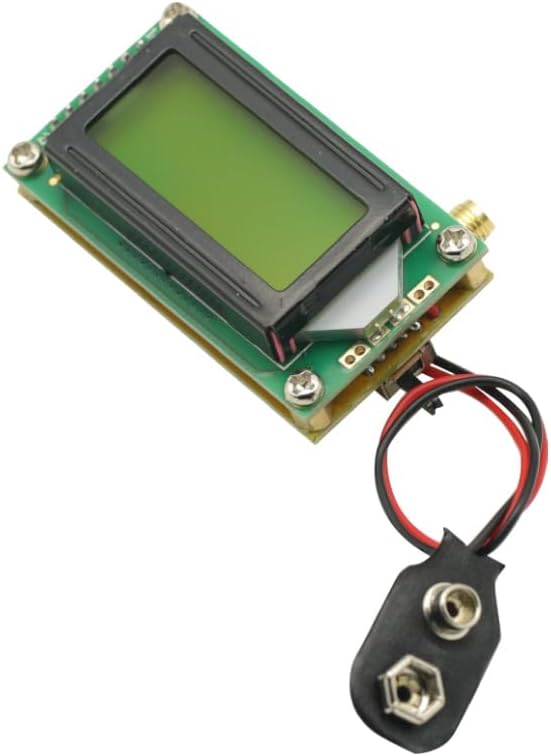
Equipped with an 0802 LCD display the module allows users to read frequency data directly though accuracy is limited to adjusting decimal precision in specific ways. The PCB and FR4 construction ensure durability while keeping the unit compact for integration into custom test rigs or enclosures.
Users should note that precision is limited to the second decimal digit which may not satisfy high accuracy needs but suffices for general hobbyist testing. The module style means additional housing and power must be arranged by the user rather than coming as a complete handheld product.
This counter is best suited for electronics enthusiasts building custom test tools or learning RF measurement fundamentals on a budget. While it lacks the polish of commercial units it offers functional frequency verification for those comfortable with basic assembly and customization.
The module format allows integration into custom projects which appeals to makers looking to build their own test equipment or learn RF measurement principles hands on.
Constructed with PCB and FR4 materials the unit maintains a small footprint that fits easily into prototyping setups or compact enclosures for portable DIY use.
We may earn a commission when you buy through this link, at no additional cost to you.
This frequency counter meter board provides an affordable entry point for ham radio operators interested in DIY measurement solutions. Covering one to five hundred megahertz it serves as a compact tool for basic RF verification and testing within the lower amateur bands.
We may earn a commission when you buy through this link, at no additional cost to you.
The unit includes an LCD display for reading frequency values and features low power consumption which makes it efficient for battery powered test rigs. Designed as a kit component it encourages users to build or integrate the counter into their own test setups or station accessories.
While the frequency range is limited to five hundred megahertz it still covers many HF VHF applications commonly used in amateur radio projects. Users should be aware that assembly and integration are required which may appeal to hobbyists but deter those seeking plug and play convenience.
For those building custom test benches or learning electronics this board offers a practical and economical frequency counting solution. It meets basic measurement needs while fostering hands on engagement with RF instrumentation and amateur radio station development.
Low power consumption ensures the device can run efficiently on battery or portable power supplies which is beneficial for field kits or long duration tests.
Intended for ham radio kits this board allows users to customize their test setup and learn how frequency counters interface with other RF and digital components.
We may earn a commission when you buy through this link, at no additional cost to you.
The AURSINC TinyGTC is a high precision dual channel frequency counter designed for advanced ham radio calibration and SDR tuning tasks. With a built in GPS disciplined oscillator it achieves accuracy up to five times ten to the negative twelve per second making it ideal for critical reference measurements and long term stability.
We may earn a commission when you buy through this link, at no additional cost to you.
Its 40ps time resolution enables stable results across a broad frequency range from zero point one hertz to seven gigahertz on Channel A. The device supports battery power and intuitive touch operation including a responsive four inch touchscreen and backup jog wheel for reliable use in field conditions.
Advanced analysis functions such as real time charting histogram and FFT are available directly on the device with data export via USB or SD card. The complete accessory kit includes an active GPS antenna and coax cables so users can deploy the counter immediately for professional or serious hobbyist work.
For operators needing the highest accuracy and comprehensive analysis tools this counter stands out as a top choice despite its higher price. Its GPSDO stability and dual channel flexibility make it invaluable for calibration SDR reference verification and demanding RF testing scenarios.
The GPS disciplined oscillator with a premium TCXO provides excellent long term frequency stability locking to GPS signals for consistent reference accuracy over time.
Real time FFT and ADEV charts plus USB SD card data logging enable detailed analysis and documentation of frequency measurements for professional reporting or research.
We may earn a commission when you buy through this link, at no additional cost to you.
Selecting the right frequency counter depends on the bands you work most often the accuracy you need and whether you prioritize portability or advanced analysis features for your station or field use.
Ensure the counter supports the bands you most frequently test such as VHF UHF or specific HF ranges to avoid missing critical frequencies during routine maintenance or field deployments.
Choose a model that covers at least the most common amateur bands to ensure versatility for both analog and digital modes without requiring multiple tools.
Look for TCXO or GPS disciplined oscillators to ensure consistent readings across temperature changes or long measurement periods which is essential for legal compliance.
Higher accuracy models with ppm or sub ppm stability are valuable for calibration or SDR reference tasks where small deviations matter.
Compact handheld units are easier to carry to field events or remote sites while benchtop or larger models may offer more features for station use.
Consider weight and battery life if you plan to use the counter outdoors or during extended testing sessions.
A simple button layout allows quick access to measurements while touchscreens offer more detailed visualizations but may require more setup time.
Choose a control scheme that matches your comfort level to reduce mistakes during fast paced testing or debugging.
Features like signal strength indicators CTCSS DCS decoders or built in signal generators add practical value for troubleshooting modern radio systems.
Decoders are particularly useful if you work with digital or tone coded signals to ensure your equipment matches required protocols.
Check whether antennas power supplies or calibration cables are included as this reduces additional costs and speeds up setup.
Accessories tailored to your intended use such as SMA cables or telescopic antennas improve measurement reliability.
Robust build quality ensures survival in field conditions while a solid warranty offers protection against defects or damage during normal use.
Units with longer warranties provide peace of mind for those using counters as primary testing tools.
USB or serial connectivity allows data logging and remote control which is helpful for long term monitoring or integrating with station software.
PC integration expands capabilities beyond what the device alone can show for detailed analysis or reporting.
Connect the antenna and ensure the unit powers on before positioning near the signal source; always use attenuators or probes for high power outputs to prevent damage.
Select the appropriate measurement range on the device and allow a few seconds for stabilization before recording readings to ensure consistent data.
Store the counter in a dry protected case when not in use and keep firmware updated if supported to maintain reliability and accuracy over time.
Most amateur operators test within VHF and UHF bands so counters covering one thirty six to seventeen four megahertz and four hundred to forty seven zero megahertz are standard. Wider units include additional HF coverage for broader station testing.
For routine checks a basic oscillator may suffice but TCXO or GPS disciplined units ensure stable readings across temperature changes which is critical for precise calibration or legal compliance tests.
Many modern counters support DMR frequency verification by detecting continuous carriers even if they do not decode digital payloads. Check the specs for explicit DMR support if digital mode testing is required.
Never connect directly to transmitter outputs above the maximum input rating. Use attenuators probes or measure from a sample port to avoid damaging sensitive internal components.
A GPS disciplined oscillator provides exceptional long term stability useful for calibrating radios or verifying SDR references where even small frequency drift can affect performance or regulatory compliance.
Yes handheld counters are often used on benches for quick checks but benchtop models may offer better connectivity and resolution for detailed analysis or automation tasks.
The top picks highlight a range of options from budget friendly handheld meters to high precision analyzers suitable for varied amateur radio needs and station requirements.
Prioritize frequency range accuracy and ease of use when selecting a counter to ensure it supports your typical testing scenarios and operational environment effectively.
Check current availability and pricing before purchasing as models may vary over time and availability can differ by region or retailer for the best experience.